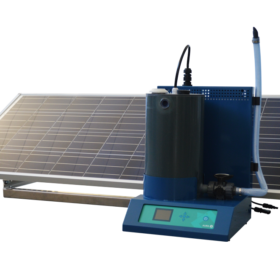
A disinfectant system powered by solar
French PV company Solea has developed a system which can produce 8-16 liters of solar-powered disinfectant solution per day.
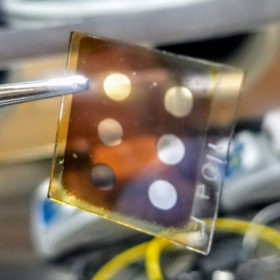
A flexible perovskite solar cell with 11.8% efficiency
U.S. researchers have created an inorganic mixed halide perovskite solar cell which they claim shows no thermal degradation even at 200 degrees Celsius for three days. The device can be used in tandem junction cells and is designed for use in real-life environments with high solar irradiation.
Chinese PV Industry Brief: Financials, a new GW-scale factory, and big hydrogen
Longi and Sungrow both announced solid financial results last week. Module maker China Solar delayed the resumption of trading on the Hong Kong stock exchange, and polysilicon producer GCL-Poly unveiled plans to raise up to US$16.8 million by issuing shares. Coal miner Baofeng Energy, meanwhile, announced the construction of what it claims will be the world’s largest PV-powered hydrogen plant, and Seraphim and Lu’An Solar revealed that they will open a 5 GW PV panel factory in China’s Jiangsu province.

US utility issues tender for 1 GW of renewables
Virginia-based utility Dominion plans to procure 16 GW of solar, 2.7 GW of storage and 5.1 GW of offshore wind in the next 15 years. Kicking off these new plans comes a request for proposals of 1 GW of solar or wind and 250 MW of energy storage.

US fossil fuel developer goes solar with 350 MW project
The economics of a solar project in Texas are so compelling coal and gas developer J-Power wants a piece of the action.
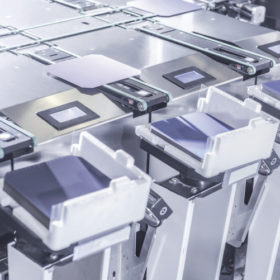
Meyer Burger mulls gigawatt-scale German solar fab
Chief executive Gunter Erfurt told a German radio station a solar factory in North Rhine-Westphalia could supply high-efficiency panels for a 10 GW floating solar project on the vast Hambach open-cast coal mine.
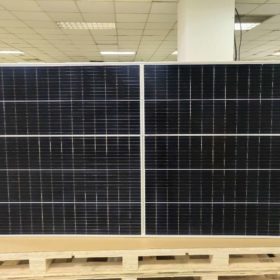
Trina secures 105 MW order for its 500 W modules
The Chinese manufacturer will provide Indian developer SunSource Energy with its Vertex panels. Shipments will be made in the fourth quarter.

Another 11 solar mini-grids for Mozambique
The public body responsible for expanding access to electricity is seeking consultants to prepare a tender for rural PV mini-grids.
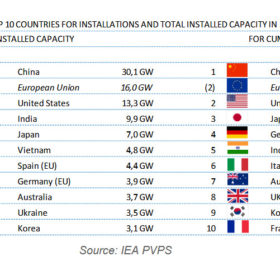
Global PV capacity additions hit 115 GW in 2019, says IEA
In terms of new solar installations, China was the world’s largest PV market for the third year in a row with 30.1 GW of fresh capacity in the 12 months to the end of December, followed by the United States with 13.3 GW and Japan with 7.7 GW.
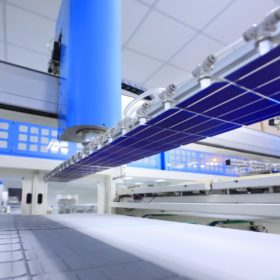
Chinese manufacturers join forces to build 5 GW module factory
Chinese solar manufacturers Seraphim and Lu’An Solar will invest around $565 million in the new factory.
