
Addressing socio-economic challenges will advance solar
In its latest monthly column for pv magazine, the European Technology and Innovation Platform for Photovoltaics (ETIP PV) presents the main findings of a recent whitepaper it published on the nexus of the socio-economic and technological challenges of solar deployment.
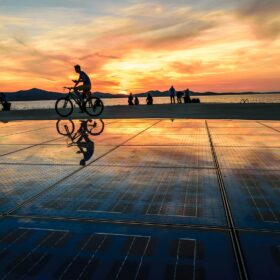
Croatia deployed 238.7 MW of solar in 2023
The Renewable Energy Sources of Croatia says the country’s total installed solar capacity now stands at 462.5 MW. It says the country will come close to entering the “gigawatt club” by the start of 2025.
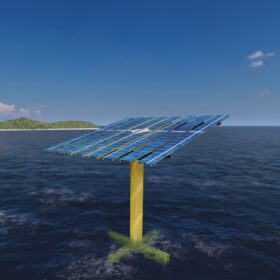
Offshore floating PV system based on dual-axis tracker, tension leg platform
Developed by scientists in Spain, the HelioSea system is reportedly able to ensure structural reliability in challenging marine environments. The research group proposed to use tension leg platforms that have been successfully applied to offshore drilling platforms, where stability is also paramount.
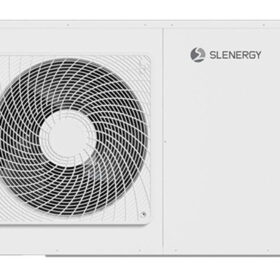
Slenergy releases residential PV system package with heat pump
Slenergy has introduced a new residential PV system package featuring 425 W solar panels, a hybrid inverter, a high-voltage battery, and a Slenergy-branded heat pump. The package incorporates Internet-of-Things hardware for real-time data collection and intelligent control strategies.
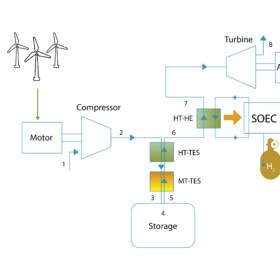
Green hydrogen, power generation tech based on compressed air storage, solid-oxide electrolysis cells
Scientists in Korea have developed a compressed air storage system that can be used as a combined cooling, heat, and power system and provide heat and power to solid-oxide electrolysis cells for hydrogen generation. It showed an overall roundtrip efficiency of 121.2% and over-unity efficiencies in the range of 100% to 120%.

Puerto Rico distributed solar rises to 680 MW, residential storage to 1.6 GWh
While distributed solar and storage are advancing quickly in Puerto Rico, utility-scale solar and storage procurements ordered by regulators in 2020 have made little progress.
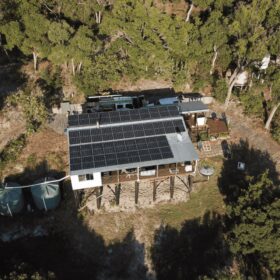
Australian off-grid project upgrade shows power of modern PV
An off-grid residential system on a secluded island in Australia has received a new tech upgrade. The additional capacity highlights the new era of off-grid living available to remote households in the country.
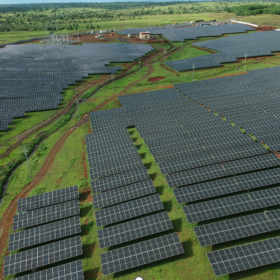
Cleantech Solar commissions 24 MW of PV under PPA in India
Cleantech Solar has commissioned 24 MW of solar in India under a power purchase agreement (PPA). It will supply power to customers in a range of sectors, including the automotive, pharmaceutical, cement, industrial equipment, and chemicals industries.
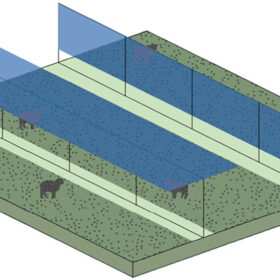
Overhead vs. vertical agrivoltaics
A survey conducted by Dutch researchers has compared the visual impact of overhead and vertical agrivoltaics farms on nearby residents and has found that vertical arrays look less invasive.

Dubai’s high-rise buildings perfect match for building-integrated photovoltaics
Scientists in the Middle East have simulated the use of different building-integrated PV systems on Dubai’s high-rise buildings. They found that for buildings with more than seven floors, BIPV may be superior to rooftop power generation.
