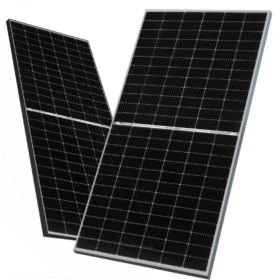
JinkoSolar claims 23.86% efficiency for n-type, TOPCon monocrystalline panel
JinkoSolar’s newest PV module has an efficiency rating of 23.86%. It is based on its TOPCon mono cell tech, which achieved a record efficiency of 26.1% in October, as confirmed by TÜV Rheinland.

India scraps solar anti-dumping probe
An entity under India’s Ministry of Commerce and Industry has terminated an anti-dumping probe into solar cells from China, Thailand, and Vietnam.
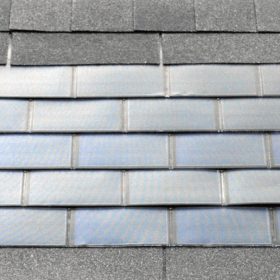
TÜV Rheinland offers certification for building-integrated PV
Germany’s TÜV Rheinland has defined safety and quality guidelines for building-integrated photovoltaic (BIPV) modules to bring more transparency to the market.
Schüco warns of more solar modules with defective backsheets
Schüco has expanded its recent warning letter about potential solar panel defects to include more products. The new list includes PV modules the company delivered between 2010 and 2014.
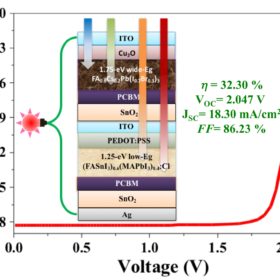
All-perovskite two-terminal tandem solar cell tech with 32.3% efficiency
Indian scientists have designed a new all-perovskite tandem solar cell configuration that can reportedly achieve higher efficiencies than similar devices built with the same materials. The top perovskite cell has a wide bandgap of 1.75 eV and the bottom perovskite cell has a bandgap of 1.25 eV.

Indian developer enters solar panel business with 2 GW factory
ReNew Power plans to switch on 2 GW of solar cell and module production capacity by September 2023.

Chinese PV Industry Brief: TBEA set to produce 120,000 MT of polysilicon in 2022
TBEA said it expects to produce 120,000 metric tons (MT) of polysilicon this year and 250,000 MT in 2023, while Daqo has revealed plans for a $700 million share buyback program.
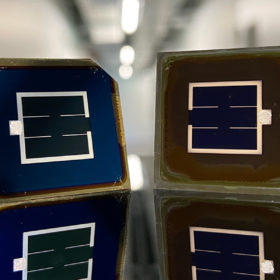
Flashing solutions for perovskite tandem cells, modules
A new white paper by testing equipment specialist Wavelabs outlines key challenges that the solar industry will face when it comes to testing and characterizing perovskite-silicon tandem cells in manufacturing environments.
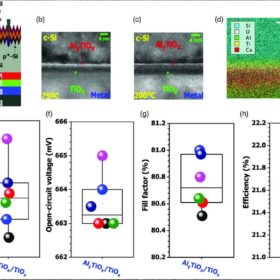
Transition metal oxides-based passivating contacts for 21.9%-efficient, n-type solar cell
An Australian research group has shown how passivating contacts based on transition metal oxides could replace contacts based on doped hydrogenated amorphous silicon or polycrystalline silicon in n-type solar cells in the future. They designed a cell with an open-circuit voltage of 665 mV, a short-circuit current of 40.78 mA cm−2, and a fill factor of 80.8%.
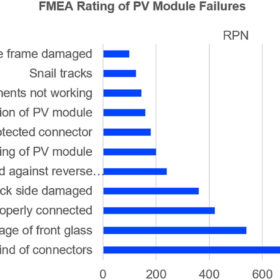
Quantitative methodologies to assess technical risks in PV
Researchers led by Germany’s TÜV Rheinland have created a database of technical risks and mitigation measures for PV installations. Their broad overview of quantification methods has shown that further standardization is required.
