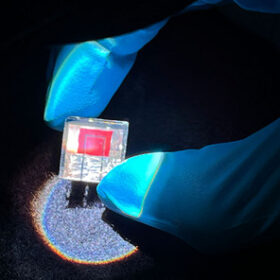
Researchers claim record-breaking 25.7% efficency for perovskite-organic tandem solar cell
Conceived by a research team from Germany’s University of Potsdam and the Chinese Academy of Sciences, the tandem cell is based on a wide-bandgap perovskite bottom cell and a narrow-bandgap organic top device. The researchers used a compound known as cyclohexane 1,4-diammonium diiodide for suface passivation.
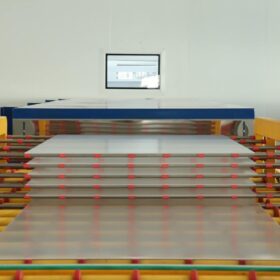
India imposes antidumping duties on solar glass from China, Vietnam
India’s Ministry of Finance has applied antidumping duties on solar glass imports from China in the range of $673 to $677 per metric ton and for imports from Vietnam at $565 per metric ton.
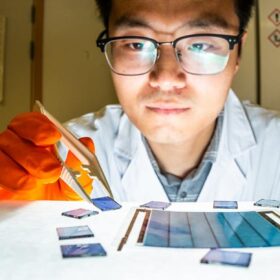
Scientists reveal factors for morphology control in organic solar cells
An international research team has fabricated organic solar cells using non-toxic solvents. The researchers identified interactions between the acceptor material side chains and the solvent, along with interactions between donor and acceptor materials, as key factors for controlling morphology in organic solar cells.
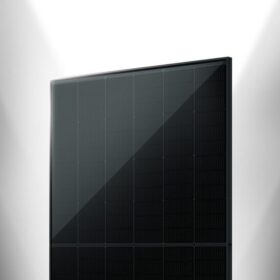
Trina Solar launches 760 W TOPCon module with 24.5% efficiency
The Chinese manufacturer said its new i-TOPCon Ultra panel is part of the Vertex N family and is intended for applications in utility-scale projects. It plans to begin mass production of the new modules in the second quarter of 2025, with an initial annual capacity of 10 GW.

Fraunhofer ISE, AMOLF unveil TOPCon solar cell based on metal nanowire grid front electrodes
The two research institutes used silver nanowire grids as an alternative to indium tin oxide for the cell’s transparent electrodes. They claim this is the first time that a metallic nanostructure offers photonic gain in a solar cell.

Wavelabs claims 0.9% uncertainty level for solar module simulator
Germany-based Wavelabs announced that its LED solar simulator Sinus-3000 Advanced has demonstrated a level of uncertainty of 0.9% for silicon solar module power measurement.
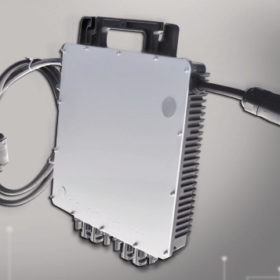
Sinovoltaics updates financial stability ranking for PV inverter manufacturers
Sinovoltaics’ latest financial stability ranking of inverter manufacturers lists Hoymiles Power Electronics, APSystems (Yuneng Technology), and Eaton in the top three positions.
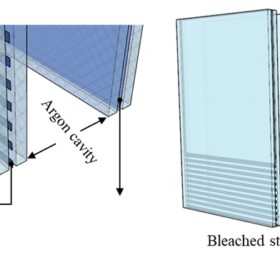
Chinese scientists develop photovoltaic window with heat flow control
The novel smart solar window combines photoelectric and electrochromic functions. It can produce electricity while also regulating the amount of solar radiation entering a building.
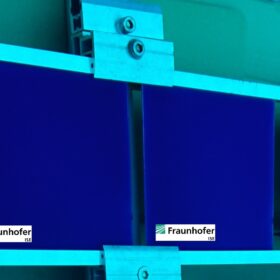
Fraunhofer ISE warns of risk from higher than expected UV-induced degradation in TOPCon, PERC, HJT cells
The researchers of the German institute explained that UV-induced degradation may cause larger than expected efficiency and voltage losses in all dominant cell technologies, including TOPCon devices. The scientists expect that silicon nitride layers could be used to enhance TOPCon UV stability compared to PECVD layers typically utilized in PERC and heterojunction cells.

Indian scientists develop 40%-efficient dye sensitzed solar cell for indoor applications
An India-based research team has boosted the power conversion efficiency and stability of indoor dye-sensitized solar cells based on co-sensitized organic dyes. The best indoor PV devices achieved 40% efficiency under 4000 lux fluorescent lighting and 10.40% under standard AM 1.5G one sun illumination.
