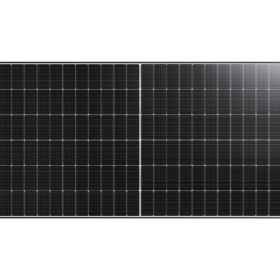
Winaico releases 525 W TOPCon solar panels
Taiwanese manufacturer Winaico has developed new 525 W TOPCon solar panels with a power conversion efficiency of 22.1% and a temperature coefficient of -0.30% per degree Celsius.

Hail-prone areas may require solar modules with 4 mm-thick front glass
New research from India claims solar modules with 3.2 mm-thick front glass may not be strong enough to withstand storms producing big hailstones. The scientists found that a front glass of at least 4 mm should be used to avoid significant damage.
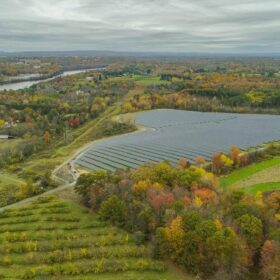
US community solar to exceed 6 GW in 2023
Following a suppressed 2022, US community solar is expected to have an upward trajectory, boosted by new state laws, the implementation of billions in grant money from the Inflation Reduction Act, and the smoothing of bumps in the supply chain.
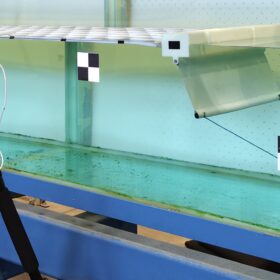
New mooring system for offshore, coastal floating PV arrays
The novel mooring solution consists of perimeter pontoons, barriers, clump weights, mooring lines and anchors. Its creators claim it is cheaper in materials and maintenance, as well as more wave-stable, compared to mooring systems using elastic cables.
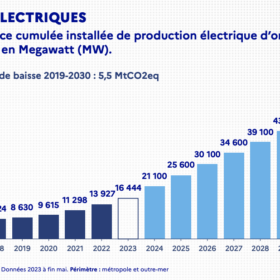
France aims for 48.1 GW of solar by 2030, 140 GW by 2050
The French government says it plans to install 48.1 GW of solar by 2030 and 140 GW by 2050. About 45 GW of the mid-century total will be generated via installations on wasteland, while 35 GW will come from rooftop installations.

Airtouch Solar launches cleaning robot solution for utility scale PV
Airtouch Solar Group has launched a cleaning solution for utility-scale solar PV plants to provide autonomous, water-free panel surface cleaning. The 4-meter cleaning unit weighs less than 40 kg and is commonly utilized in arid and dusty locations.
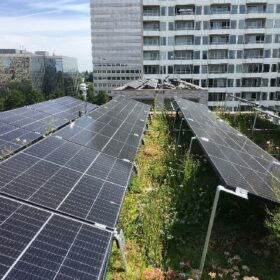
Well-irrigated roofs with vegetation have cooling effect on PV systems
Scientists in the Netherlands have assessed how the so-called blue-green roofs can help reduce the operating temperature of rooftop PV panels and have found they provide a significant cooling effect. The irrigation system used for the research project relies on an additional water supply sourced from grey water from showers that is transformed into irrigation water.

Indian oil giant enlists PV panel manufacturers for solar projects
A subsidiary of Oil and Natural Gas Corp. is recruiting solar panel suppliers and manufacturers for its future PV projects across India.

Vena launches plan to support solar, storage ‘megaproject’ in Indonesia
Singapore-based developer Vena Energy says it will investigate opportunities to make solar panel components and battery energy storage systems in Indonesia, in order to support a hybrid megaproject with up to 2 GW of solar and more than 8 GWh of energy storage.
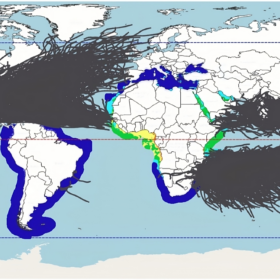
Offshore floating solar on calm seas could provide unlimited energy
In a new monthly column for pv magazine, the International Solar Energy Society (ISES) describes how regions that don’t experience waves larger than 6 m nor winds stronger than 15 m/s could generate up to one million TWh per year via offshore floating PV arrays. Most of the good sites are close to the equator, in and around Indonesia and tropical West Africa.
