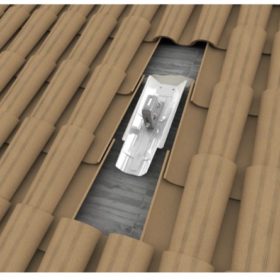
New rooftop PV bracket for sloped tile roofs
Sun Age, an Italian mounting system supplier, has developed a special bracket for rooftop PV installations on sloped tile rooftops. It is made of stainless steel and can be deployed by fixing it to the surface with dowels or glue.
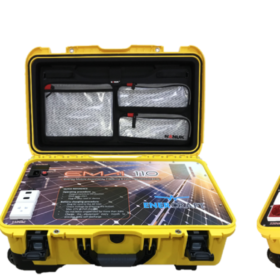
Spanish start-up unveils 1kWh portable battery for multiple uses
The portable storage system contains lithium batteries, a charger, and an inverter, all fully integrated into a sealed and protective case.

RenewSys expands solar encapsulant capacity to 3 GW, aims for 11 GW
Solar manufacturer RenewSys has expanded its encapsulant capacity to 3GW with the addition of a new line at its facility in Bengaluru, India. The company aims to eventually expand its encapsulant capacity to 11 GW.
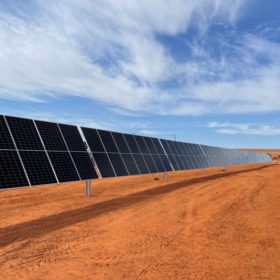
Pacific Energy unveils hybrid power solution based on PV, electric turbo compounding
KPS Power Generation has converted a 10 MW diesel-fueled power station at a mine in South Australia into a hybrid PV facility.
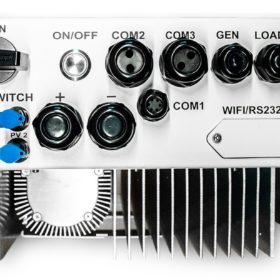
New hybrid inverters for rooftop PV from Germany
The BW-HY3600 and BW-HY4600 inverters can be integrated with existing on-grid or off-grid PV systems and a battery storage system of 48V. Both devices, according to German manufacturer Bosswerk, have AC and DC coupling and are particularly suitable for residential and commercial solar arrays.
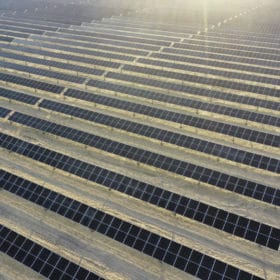
Oman inaugurates 500MW Ibri 2 solar field
Some 1.5 million bifacial panels make up the power plant in Ad-Dhahirah governorate which was constructed in just 13 months by ACWA Power, the Gulf Investment Corporation and Kuwaiti developer Alternative Energy Projects Co.

Quantum dot layer pushes perovskite solar cell efficiency up to 25.7%
Researchers in Switzerland have replaced the electron transport layers in perovskite solar cells with a thin layer of quantum dots. On an area of 0.08cm2, they achieved a record efficiency of 25.7% and high operational stability.
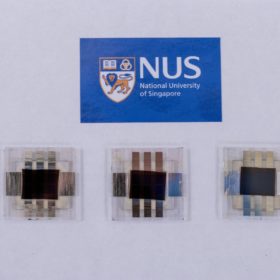
Perovskite-organic tandem PV cell with 23.6% efficiency via optimized interconnecting layer
Scientists in Singapore have developed a cell that could be used to power vehicles and boats, among other applications. The tandem device purportedly retains 90% initial efficiency after 500 hours of maximum power point tracking under continuous one sun illumination.
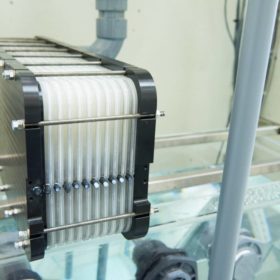
Zinc-air battery, CHP and PV to power apartment complex in New York
A 100kW/1.5MWh zinc-air battery will be installed in Queens, New York, in combination with a combined heat and power system and a PV array. The pilot project is intended to demonstrate the long-duration energy storage capability of the zinc-air battery.
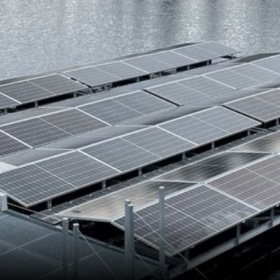
Czechia’s first floating photovoltaic plant
Operated by Czech utility CEZ Group, the pilot solar plant will be located at different heights during the charge and recharge cycles of a pumped-hydro plant and the difference in height may reach up to nine meters.
