
20-month field tests show tracker-based bifacial PV outpeforms fixed tilt counterparts with 13.5% higher ouput in desert enviroments
Qatari researchers found that bifacial 2P horizontal single-axis tracking PV systems in desert conditions produced up to 13.5% more electricity than fixed-tilt systems over long-term field testing in Qatar. The study also showed strong seasonal and technology-dependent performance, with tracker advantages varying with irradiance and weather conditions.
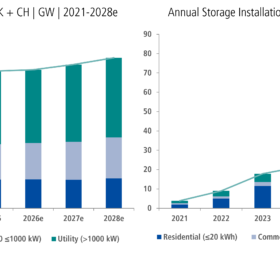
Europe’s solar and storage development: Selectivity amid rising global supply and returning energy shocks
Escalating Middle East tensions and global energy supply risks are accelerating Europe’s shift toward solar and storage, particularly in commercial, industrial, and utility-scale segments where energy security, resilience, and price stability are becoming central investment drivers. At the same time, expanding manufacturing capacity in China and India is redirecting surplus solar and storage supply toward Europe, creating a highly competitive and increasingly selective market where long-term success depends on quality, reliability, ESG alignment, and strategic market positioning.
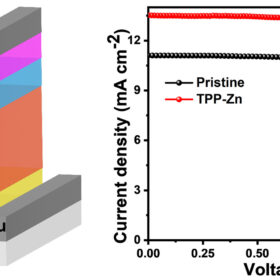
Inorganic perovskite solar cell based on tetraphenyl-porphine zinc interlayer achieves 82% fill factor
An international research team has proposed a perovskite solar cell architecture incorporating a thin tetraphenyl-porphine zinc interfacial layer to enhance surface potential, passivate defect states, and improve charge transport. The strategy leads to improved device efficiency and operational stability, enabling power conversion efficiencies exceeding 13%.

Australian researchers develop vapour-based manufacturing process for lead-free perovskite solar
Researchers at the University of Queensland have developed a scalable, lead-free perovskite solar cell manufacturing process that achieves record indoor-light efficiency while avoiding toxic materials and enabling flexible consumer electronics applications.
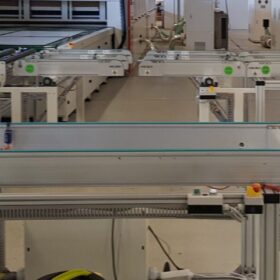
German solar module maker Soluxtec files for insolvency
Soluxtec has entered provisional insolvency proceedings as declining module prices and international competition continue to pressure European solar manufacturers. The company said it plans to restructure operations, maintain module deliveries, and preserve jobs while seeking investors.

Anker Solix launches 7 kWh modular battery with 5 kWh bidirectional inverter
The system features AI-driven energy management, 10,000-cycle battery life, and scalable expansion up to 126 kWh.

Gotion unveils 5 MW/18.8 MWh ensclosed battery storage system
While the exact specifications of the new product, such as dimensions and weight, haven’t been disclosed, available imagery suggests potential transportation challenges.

Scientists discover why lead-halide solar perovskites work efficiently despite being structurally ‘messy’
Researchers in Austria found that unusually high photovoltaic efficiency in lead-halide perovskites can be explained by internal electric fields generated at strain-induced domain walls, which separate charge carriers and enable long-range transport. Their experiments indicated that these effects arise from mesoscopic structural inhomogeneities rather than a uniform crystal structure, providing a general mechanism for charge separation in these materials.
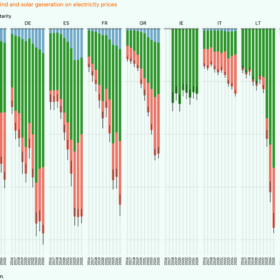
Renewables growth cut Spain’s electricity bills by 24.2% over the past two years
Spain and Portugal are 53% less exposed to gas price volatility than they were three years ago, according to a new report from Positive Money.
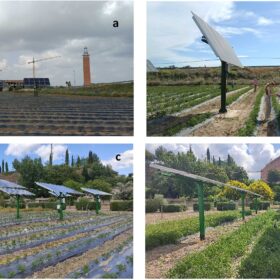
New irrigation tech helps reduce water use in agrivoltaics
Spanish researchers found that combining agrivoltaics with regulated deficit irrigation (RDI) can cut tomato irrigation water use by about 50%, while improving land-use efficiency through simultaneous crop and solar energy production.
