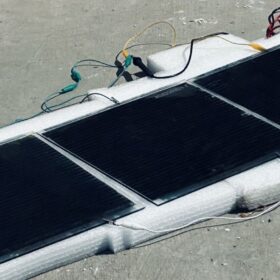
Indian startup testing 15%-efficient perovskite solar modules
P3C Technology and Solutions plans to initially produce the 30 cm2 modules at a pilot 60 MW manufacturing facility.
Tilt angle has greatest impact on power losses caused by soiling
Scientists in China have analyzed the impact of soiling of PV module performance and have found that tilt angle has the greatest impact, followed by irradiance intensity and dust deposition density.

Testing photovoltaic modules in Antarctica’s summer
The Turkish Antarctic Expedition placed four different PV module types – monocrystalline, polycrystalline, flexible and transparent – outside of their research camp for three months to compare performance, finding that monocrystalline was the clear winner.

Unlimited energy storage in Europe
Most studies of European 100% renewable energy overlook pumped-hydro energy storage (PHES), for the following, incorrect, reasons: there are few PHES sites; more dams on rivers are required; large areas of land are flooded; large amounts of water are required; there is a heavy environmental cost; and the capital cost of PHES is high. All these perceptions are wrong.
U.S. residential solar declined 31% in 2024
Wood Mackenzie reports that the United States installed around 4.7 GW of new residential PV capacity in 2024.

Belgium’s Wallonia region added 92 MW of solar in 2024
The rate of solar installations slowed in the Belgian region of Wallonia last year, as government incentives for residential solar came to an end. Brussels-based renewable energy federation Edora says deployment will need to accelerate across all market segments if the region is to meet its 2030 solar targets.
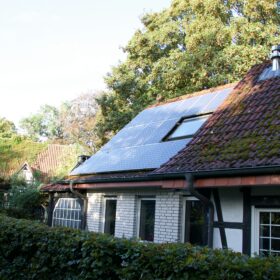
Rooftop solar could supply two-thirds of global power, study finds
Researchers at the University of Sussex have found that widespread deployment of rooftop solar could cover the vast majority of the world’s electricity consumption, while lowering global temperatures by up to 0.13 C.

South African province launches agrivoltaics tender
South Africa’s Mpumalanga province is seeking developers to partner with its Department of Agriculture, Rural Development, Land, and Environmental Affairs to establish and operate agrivoltaics at selected sites, with applications due by April 10.
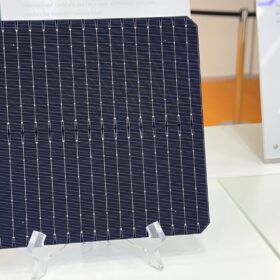
India’s MNRE says imported silicon wafers do not meet domestic PV criteria
India’s Ministry of New and Renewable Energy (MNRE) has ruled that solar cells made with imported diffused silicon wafers, known as “blue wafers,” do not qualify for government programs requiring domestically manufactured PV cells.
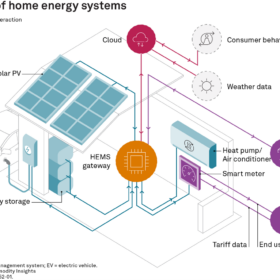
Energy management systems key to helping residential customers navigate increasingly complex energy markets
Home Energy Management Systems (HEMS) are emerging as essential tools, enabling consumers to navigate grid complexities, optimize energy usage, and contribute to a more resilient and low-carbon grid.
