
Canadian startup secures patent for solar module cooling tech
Enertopia has developed a solar module cooling system that uses a moisture collection layer to transfer heat while capturing water for irrigation in arid regions. The design channels heat from the panel to a liquid transfer system, improving efficiency and water use.

India’s solar module exports hit $782 million in April-November 2024
India exported $782 million worth of PV modules from April to November 2024, with $756.08 million shipped to the United States, says Indian Minister of State for New and Renewable Energy Shripad Yesso Naik.
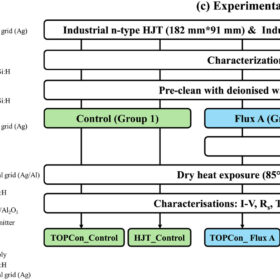
Study shows sensitivity of heterojunction solar cells to soldering flux
An international research team has assessed the impact of soldering flux on heterojunction solar cells and has found that the composition of this component is key to prevent major cracks and significant peeling.
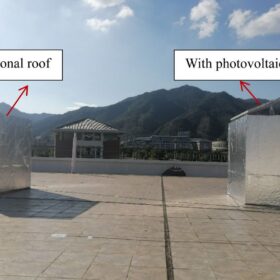
New research suggests optimal tilt angle, overhead height for rooftop PV systems
Researchers in China have investigated the effect of the overhead height and tilt angle on thermal and energy-saving performance of photovoltaic roof and have found that the comprehensive energy-saving efficiency of parallel overhead photovoltaic roofs are optimal in summer and the worst in winter.

Solar thermal developer ticks off final technology milestone
Vast Renewables has successfully completed large-scale testing of a concentrated solar thermal power receiver tower destined to be deployed as part of a 30 MW / 288 MWh solar and energy storage project planned for South Australia.

The Hydrogen Stream: TalusAg starts green ammonia production in Iowa
Landus and TalusAg have launched commercial green ammonia production in Iowa, backed by US federal clean hydrogen tax credits, while Iberdrola España and BP have started building Spain’s largest green hydrogen project, with 25 MW of capacity.

Chinese PV Industry Brief: Huasun secures 3 GW HJT solar panel order
Huasun Energy says it has signed a 3 GW supply deal with Hongyang New Energy Development Group for heterojunction (HJT) solar panels. The PV modules will be used in Hongyang’s solar-plus-storage hydrogen-ammonia projects in China’s Xinjiang region, with delivery set by the end of 2026.

US startup developing defrost-free residential heat pump for cold climates
TerraVis Energy claims its new heat pump system can achieve a seasonal coefficient performance of 3.5 and deliver 30 C of heat indoors at -50 C. CEO Lorenzo Rossi told pv magazine that the system could be produced at a lower cost than conventional models.

Philippines certifies 17.6 GW of renewables under CEPNS program
The government of the Philippines issued Certificates of Energy Projects of National Significance (CEPNS) for 149 power and transmission projects between May and December 2024, covering 91 renewable energy projects totaling 17.6 GW of capacity.

Swedish startup offers n-type conductive inks for organic, perovskite solar cells
N-ink, a spinoff of the Linköping University, has developed conductive inks that can be used in the charge extracting layer of organic solar cells and in transport layers of perovskite solar cells.
