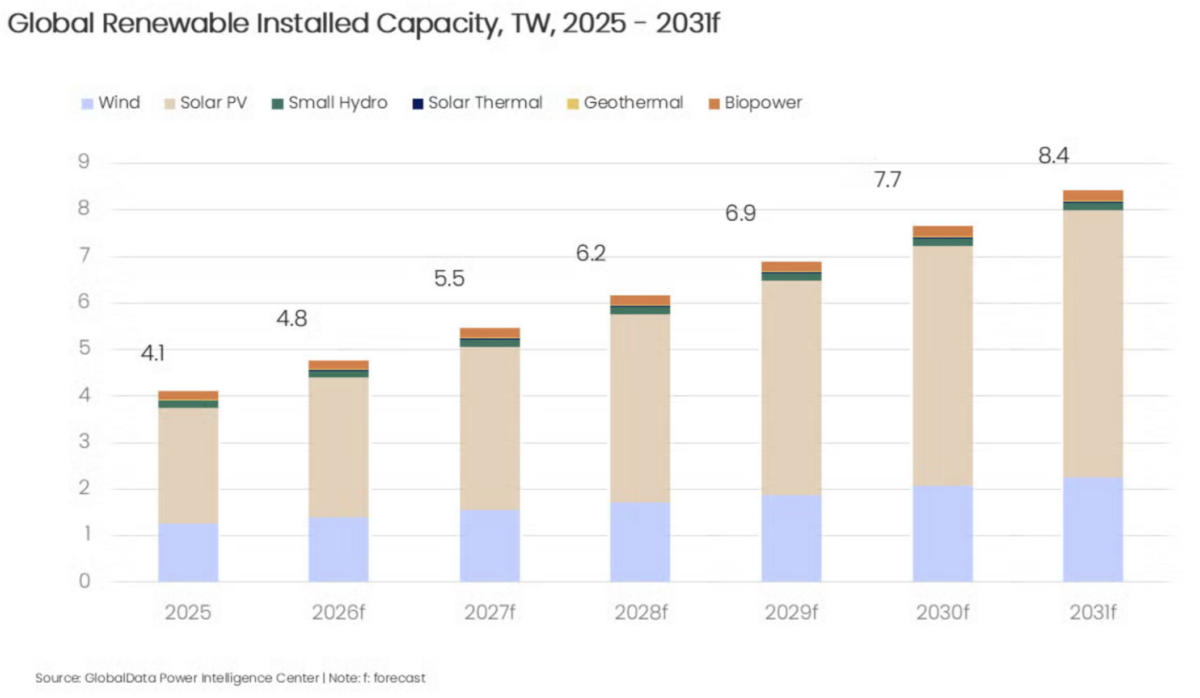
GlobalData says global renewable capacity will more than double to 8.4 TW by 2031, with PV reaching nearly 6 TW, a 13% compound annual growth rate from 2025 levels of 4.1 TW.
The “Renewable Energy: Strategic Intelligence” report says solar has become the main driver of global renewable expansion due to falling costs and supportive energy transition policies. PV generation reached 2,800 TWh in 2025, surpassing wind generation of 2,770 TWh.
In capacity terms, solar accounted for about 56.1% of global renewable capacity in 2025 with more than 2.5 TW installed. Wind represented 33.5% of total capacity, while bioenergy contributed around 5.3%.
The Asia-Pacific region led global deployment, with 699.5 GW of installed wind capacity and 1,550 GW of solar capacity in 2025. China generated about 1,150 TWh of solar electricity that year, representing around 41% of global PV output.
The United States and India followed China as major solar producers, generating 486 TWh and 189 TWh of PV electricity respectively.
GlobalData also says the energy transition is developing unevenly across regions. While renewable support in the United States could weaken following policy changes under US President Donald Trump, deployment in other regions continues to accelerate.
The report also highlights the growing role of artificial intelligence in the power sector. AI is being used to improve renewable generation forecasting, optimize energy storage dispatch and coordinate smart grid operations, while rapid growth in AI data centers is creating new large-scale electricity demand.







By submitting this form you agree to pv magazine using your data for the purposes of publishing your comment.
Your personal data will only be disclosed or otherwise transmitted to third parties for the purposes of spam filtering or if this is necessary for technical maintenance of the website. Any other transfer to third parties will not take place unless this is justified on the basis of applicable data protection regulations or if pv magazine is legally obliged to do so.
You may revoke this consent at any time with effect for the future, in which case your personal data will be deleted immediately. Otherwise, your data will be deleted if pv magazine has processed your request or the purpose of data storage is fulfilled.
Further information on data privacy can be found in our Data Protection Policy.