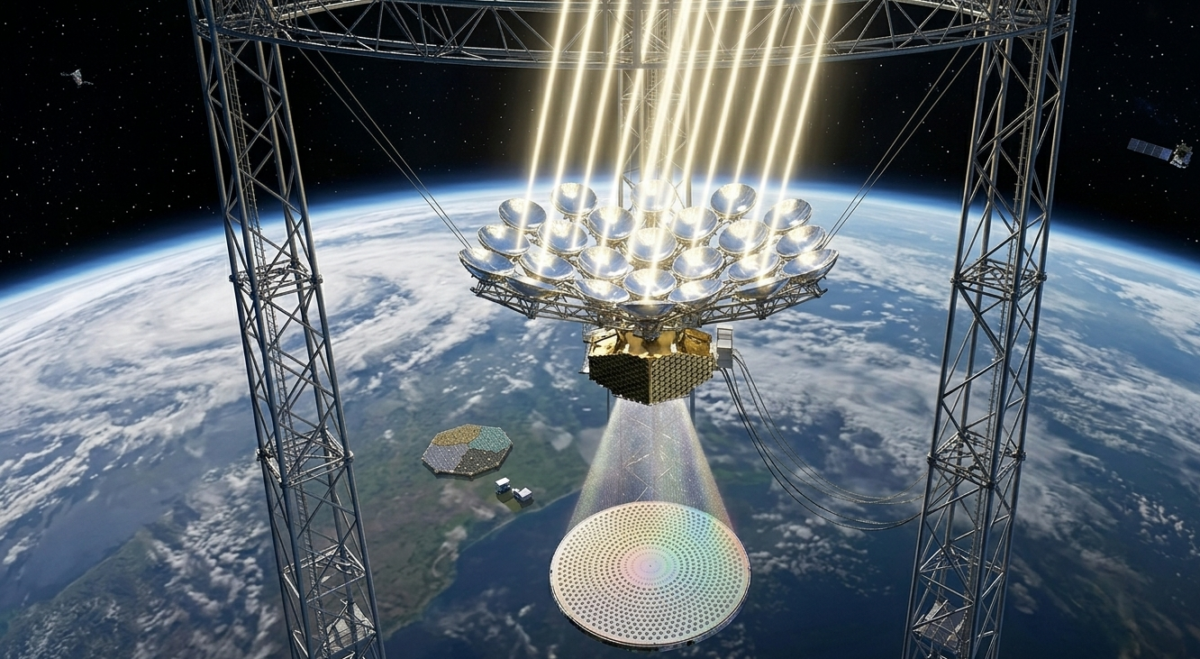





A research team from China’s Xidian University has begun initial experiments under the Sun Chasing project, an initiative aimed at developing large-scale space-based solar power systems. The long-term goal is to deploy orbital solar infrastructure capable of collecting energy in space and transmitting it wirelessly back to Earth or to spacecraft, potentially providing a continuous and weather-independent power source.
The research team reports that it has successfully demonstrated wireless power transmission over distances exceeding 100 meters to a stationary target, as well as more than 30 meters to a moving target. According to the project team, these early tests are intended to validate key components of the system, including beam stability and energy delivery accuracy under changing conditions.
“In recent tests, the system achieved a wireless power transmission efficiency of 20.8% from direct current to direct current over a distance of 100 meters. It delivered 1,180 watts of power,” the Chinese State Council Information Office said in a statement. “The team has also built a wireless charging system for drones. In a test, a drone flying at 30 kilometers per hour was able to receive 143 watts of stable power from 30 meters away.”
In the proposed system configuration, solar energy is first collected using spherical crown concentrators, which are designed to efficiently capture and focus incoming sunlight across a wide surface area. This concentrated solar energy is then converted into electrical power through onboard conversion systems. Once converted, the energy is transformed into microwave radiation for wireless transmission.
The microwave signal is generated and directed by a circular active phased array antenna with a diameter of 1.2 meters. This phased array enables precise beam steering and control, allowing the microwave energy to be tightly focused toward a designated receiving station despite distance and relative movement.
At the receiving end, the transmitted microwave beam is captured by a rectifying antenna, called rectenna, which measures 5.2 meters in diameter. The rectenna converts the incoming microwave energy back into usable electrical power with high efficiency, reportedly capturing around 87% of the emitted microwave power under the test conditions.
The Sun Chasing project was initiated in 2018 and reached a major milestone in 2022 with the completion of a full-system ground validation. In 2024, the team reported a successful power transmission over a distance of more than 55 meters.
“Recent breakthroughs include improving the efficiency of solar energy collection and conversion, increasing the precision of microwave beam control to reduce energy loss, and making the transmitting and receiving antennas smaller and lighter, which is critical for space applications,” said Duan Baoyan from Xidian University. “We have also solved the problem of how to power multiple moving targets at once using a single transmitter. This means that in the future, one space power station could potentially supply electricity to several satellites or ground vehicles at the same time.”
The researchers noted, however, that there is still a long way to go before a space solar power station becomes a commercially viable reality. “The next step is to conduct in-orbit tests,” they said.
This content is protected by copyright and may not be reused. If you want to cooperate with us and would like to reuse some of our content, please contact: editors@pv-magazine.com.


By submitting this form you agree to pv magazine using your data for the purposes of publishing your comment.
Your personal data will only be disclosed or otherwise transmitted to third parties for the purposes of spam filtering or if this is necessary for technical maintenance of the website. Any other transfer to third parties will not take place unless this is justified on the basis of applicable data protection regulations or if pv magazine is legally obliged to do so.
You may revoke this consent at any time with effect for the future, in which case your personal data will be deleted immediately. Otherwise, your data will be deleted if pv magazine has processed your request or the purpose of data storage is fulfilled.
Further information on data privacy can be found in our Data Protection Policy.