
Dutch long-duration energy storage project targets sub-€50/kWh costs with innovative technologies
The SLDBatt project brings together TRL 7 battery technologies – including molten sodium‑salt, saltwater acid–base flow, and hydrogen–iron flow batteries – to deliver an innovative and cost-effective long-duration energy storage solution.
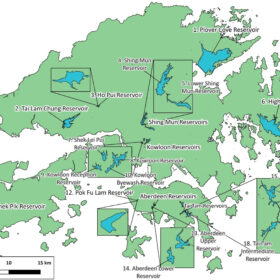
Floating PV could power up to 490,000 households in Hong Kong
Hong Kong has limited land, and researchers have checked how much of the city can be powered if most of its water reservoirs were to be fully or partially covered with floating PV systems. At best, full coverage can supply more than 15% of the city’s total demand, and more than 60% of the residential demand.
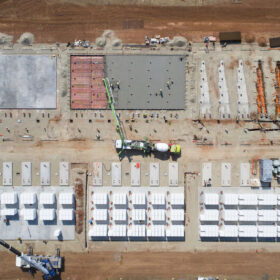
Neoen’s battery to pioneer grid-forming services on French transmission network
At a major battery project, RTE and Neoen are trialing an inverter retrofit, marking a first for grid-forming services on France’s transmission network.

Swiss researchers improve electrolyte design for long-life solid-state batteries
A Swiss research team has developed a low-temperature sintering and interface-coating process that significantly improves the durability of argyrodite-based solid-state batteries. The approach delivers high ionic conductivity and long cycle life, retaining 75% of capacity after 1,500 cycles.
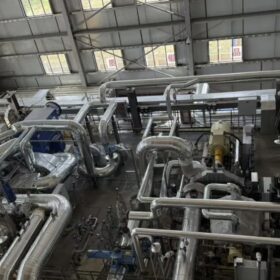
World-first 560 C Carnot battery unveiled as SPIC launches ultra-high-temperature heat storage
Chinese state-owned power group SPIC has launched a 1 MW / 4 MWh pilot, showcasing a long-duration energy storage alternative to conventional lithium-ion batteries and compressed air energy storage (CAES).
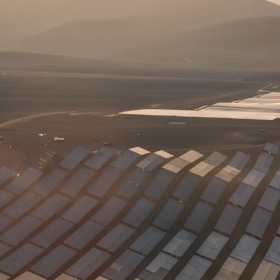
Pacific Hydro commissions 293 MW of PV with 110 MW/220 MWh of storage in Chile
Pacific Hydro has brought its 293 MW Desierto de Atacama solar project online with 110 MW/220 MWh of battery storage. The Atacama Desert facility is expected to supply 780 GWh of clean electricity annually to more than 310,000 homes.
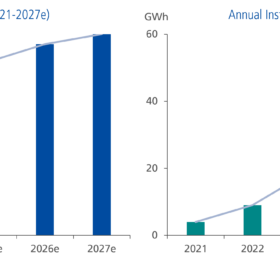
Global solar enters period of adjustment, as market conditions redefine rules of competition
Global solar growth is flattening in major markets as oversupply from China and India drives prices down and shifts competition from sheer volume to execution, policy alignment, and system integration. Across the U.S., Europe, and China, energy storage is becoming essential for project viability, making PV-plus-storage and strong EPC partnerships the new basis for winning projects in 2026 and beyond.
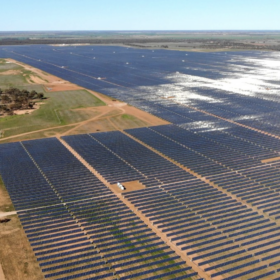
Australian state’s utility-scale solar tops 1 TWh in December
Solar farms in New South Wales led the way for Australia’s utility-scale PV energy output in December 2025, generating 1,052 GWh of renewable electricity.
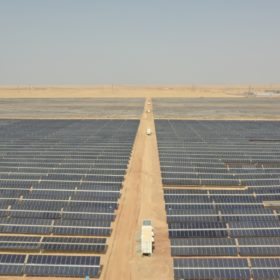
Scatec secures PPA for Africa’s largest solar-plus-storage project
Scatec has inked a 25-year power purchase agreement in Egypt for a 1.95 GW solar, 3.9 GWh battery energy storage project, representing the developer’s largest investment to date.
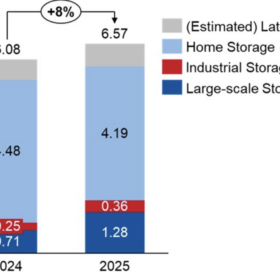
Germany adds 6.57 GWh of battery storage in 2025, total hits 24 GWh
Germany added an estimated 6.57 GWh of stationary battery storage capacity in 2025, an increase of about 8% year on year, lifting total installed capacity to roughly 24 GWh. Growth was driven by industrial and large-scale systems, even as home storage installations declined alongside weaker rooftop solar demand.
