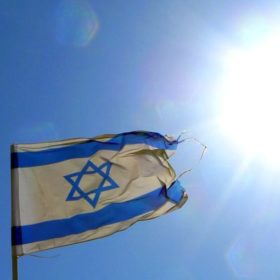
Can Israeli PV tenders preserve competition in a concentrated market?
Researchers have studied Israel’s clearing price method for PV tenders and raised concerns about its potential for long-term dominance. They examined how power abuse and technological inefficiencies lead to market inefficiencies, concluding that a duopoly best suits the Israeli market.
Germany adds 960 MW of solar in September
Germany installed 960 MW of solar in September, bringing its cumulative PV capacity to more than 94.52 GW.
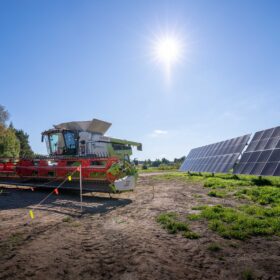
Sweden’s first large-scale agrivoltaic park inaugurated
Production is now underway at Sweden’s first large-scale agrivoltaics park, owned and operated by Svea Solar. A power purchase agreement is in place with a local vertical farmer for the electricity produced, while the farm underneath the solar panels will produce rapeseed, ley and wheat on a rotational basis.
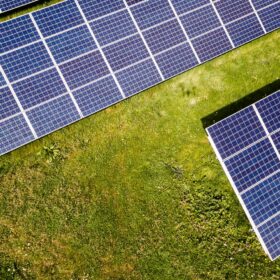
UK’s largest PPA to date signed for 373 MW solar park
Quinbrook Infrastructure Partners announces two long-term agreements covering 100% of solar power generation at Cleve Hill Solar Park. British supermarket retailer Tesco has signed a 15-year agreement covering 65% of generation and Shell will manage remaining capacity under 10-year route-to-market deal.

Germany wraps up ‘innovative’ tender with average price of €0.0709/kWh
Germany has concluded a new renewables tender, securing 583 MW of capacity at an average price of €0.0709 ($0.0771)/kWh.

PV fault detection method based on deep learning of aerial images
Conceived an international research group, the proposed model uses the convolutional neural network (CNN) architecture U-Net for image segmentation and the the CNN architecture InceptionV3-Net for fault classification.

Research on agrivoltaics in Germany demonstrates strong synergies
Recent research conducted by Germany’s Fraunhofer ISE on agrivoltaics show that not only did the crops grown under the PV panels benefit from the partial shading, but also that the PV system produced more electricity than previously assumed thanks to the cooling provided by the plants underneath.
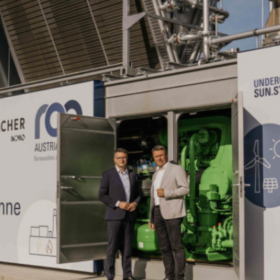
The Hydrogen Stream: Innio starts hydrogen-fueled CHP plant in Austria
Innio Group has started operating a combined heat and power (CHP) plant for heating purposes in Austria, while PureWave Hydrogen has told pv magazine that it is exploring geological hydrogen in Kansas using proprietary software and an AI system.
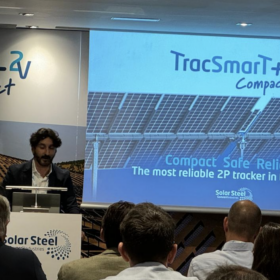
Gonvarri Solar Steel unveils new tracker
Spain’s Gonvarri Solar Steel claims that its new single-row tracker can improve structural stability and performance in adverse conditions.

Japan’s oldest PV system gets refurbished
Tokyo-based startup Girasol Energy and the enterprise bureau of Japan’s Yamanashi prefecture have repowered Japan’s oldest PV system, a 100 kW array built in 1993. The project aimed to partially replace the original 13.3% efficient solar modules, offering an alternative to dismantling and recycling the system’s components.
