
Poland’s massive new airport project to host utility-scale solar-plus-storage project
Poland’s Central Transport Port company tendered 20 MW of solar PV plus 50 MW of battery storage capacity with a working time of two hours. The project’s capacities could be expanded in the future, when the Port Polska airport will be fully operational.

Türkiye installs 4.7 GW of solar in 2025
Türkiye’s cumulative solar capacity is approaching 25 GW after another strong year for new deployments, led by installations for self-consumption in the commercial and industrial market.
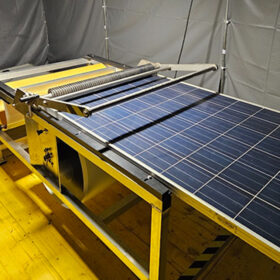
French startup offers on-site solar module repair solution
France-based DOTSun has developed an on-site repair solution for solar panels with degraded backsheets, compatible with PA, PVDF, and PET types. The system uses a compact laminator to apply a protective film to the rear side of the module, reportedly restoring insulation and extending the service life of up to 2,000 panels per site.

Saudi Arabia reveals qualified bidders for 3.1 GW solar auction
Saudi Power Procurement Co. (SPPC) has announced the qualified developers for the seventh round of Saudi Arabia’s renewable energy tender program, featuring four solar projects with a combined capacity of 3.1 GW.
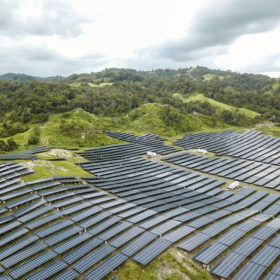
Grid code standards key to unlock Indonesia’s solar potential
New research shows how modern technical standards, combined with broader regulatory and grid reforms, are essential to ensure system reliability in the Indonesian electricity system as renewable capacity grows.

Serbia tenders design, feasibility study of solar project
Serbian utility Elektroprivreda Srbije (EPS) is seeking bids for a feasibility study and design of a solar plant on an existing thermal power plant’s ash disposal site, with applications due by Jan. 23.

Peru adds 454 MW of large-scale PV in 2025
Peru commissioned about 454 MW of utility-scale solar capacity in 2025, taking cumulative installed PV capacity to roughly 952 MW, according to the government.

Germany adds 17.5 GW of solar in 2025
Germany installed about 17.5 GW of new PV capacity in 2025, taking cumulative installations past 117 GW by year end, according to preliminary data from the German Solar Association.
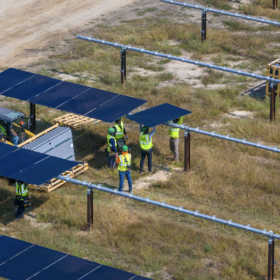
US state repurposes wastewater land for 250 MW solar plant
Consumers Energy has switched on a 250 MW solar project in western Michigan built on an active municipal wastewater treatment site, using a dedicated 138 kV grid connection.

France, Germany, Italy break solar records in December
AleaSoft Energy Forecasting’s latest analysis finds Germany broke its record for solar production on a day in December on Christmas Day, reaching 87 GWh, while Italy and France achieved the same feat three days later, registering 66 GWh and 54 GWh respectively.
