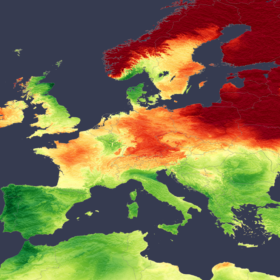
Storm train hits Western Europe PV as East clears under cold
In a new weekly update for pv magazine, Solcast, a DNV company, reports that January 2026 saw Europe’s coldest month since 2010, with Eastern Europe and Scandinavia enjoying above-average solar irradiance under stable, dry air, while the UK, Spain, and Portugal faced record cloudiness and rainfall that sharply reduced PV output.

China wafer prices fall for fourth week as discounting deepens under inventory pressure
In a new weekly update for pv magazine, OPIS, a Dow Jones company, provides a quick look at the main price trends in the global PV industry.

Sunoyster offers lightweight 440 W glass-covered TOPCon PV panel
Germany-based solar tracker developer Sunoyster Systems has developed a 440 W lightweight solar panel with a tempered glass cover for low-load commercial and industrial roofs.

NexWafe, Talon PV sign 7 GW solar wafer supply agreement
Under the terms of the deal, Germany’s NexWafe will supply its ultrathin solar wafers to Talon PV’s planned 4.8 GW TOPCon solar cell manufacturing plant in Texas. Initial qualification work will take place at a pilot production line at Fraunhofer ISE’s Photovoltaic Technology Evaluation Center.
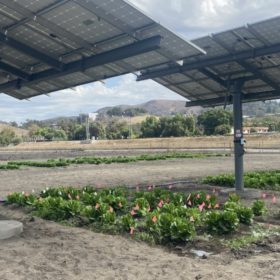
Agrivoltaics for regenerative agriculture
U.S. researchers are testing regenerative agrivoltaics at a farm in Southern California, combining solar panels with soil-restoring practices like composting, cover cropping, and no-till farming to enhance crop yields, soil health, and water-use efficiency. The pilot evaluates technical, ecological, and economic viability while exploring how this land-sharing approach can optimize food and energy production, reduce irrigation needs, and inform larger-scale deployment and policy frameworks.

New single-diode model tackles recombination losses in solar cells
UNSW researchers have developed an intrinsic-adjusted single-diode model that explicitly accounts for radiative and Auger recombination, improving I–V curve accuracy and reducing root mean square error by up to a factor of three. The model is claimed to better predict performance near open-circuit voltage and maximum power point.
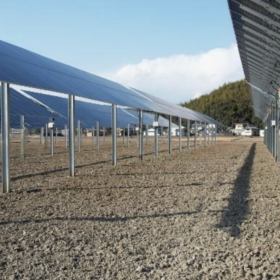
Idemitsu switches on 2 MW of solar above rice paddy
Japanese petroleum company Idemitsu Kosan has announced its 2 MW agricultural solar power plant, installed 3.8 meters above a rice paddy, has begun operating. The project features a community-based model that returns a portion of the profits from power generation to the farmers.

Anti-glare film enables PV system at Brussels Airport
Warehouses De Pauw (WDP) has installed an 8.5 MW solar system at a warehouse near Brussels-Charleroi Airport, equipping roughly 40% of modules with Phytonics anti-glare film to prevent air traffic disruption while maintaining near-full energy output.
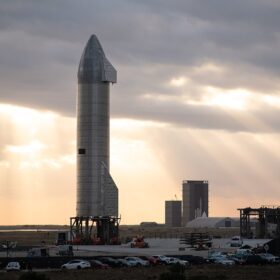
Space-based solar could be competitive by 2040, UK government finds
Investment and support could make small-scale space-based solar power (SBSP) viable, with potential for electricity generated in orbit to participate in UK contracts for difference (CfD) scheme according to new report. Launch costs have biggest impact on levelized cost of electricity (LCOE), according to analysis.

The effects of solar module elevation on ground-mounted PV
Scientists in Hungary found that ground-mounted PV modules at an intermediate elevation of 1.1 m achieve the highest efficiency and power output due to improved airflow and reduced cell temperature. Their study also estimated a levelized cost of electricity of $0.0843/kWh and 577.78 kg CO₂ mitigation over 25 years, while noting results are specific to concrete surfaces.
