
Chinese PV Industry Brief: Solar glass prices on the rise
Solar glass prices continued to climb this week, with 2.0 mm sheets rising 8% to CNY 13.5 ($1.85) per square meter and 3.2 mm sheets up 9.8% to CNY 22.5, according to the China Nonferrous Metals Industry Association (CNMIA).
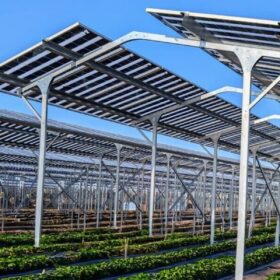
Grid Parity unveils new glass-glass module for agrivoltaic systems
The translucent 320 W solar module will be presented for the first time in Rimini, Italy. It will be produced by production partner Agora in Slovakia from the third quarter.
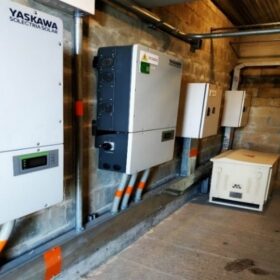
New technique to predict solar inverter temperature
An international research team has developed a novel approach for predicting inverter temperature through symbolic regression based on particle swarm optimization.
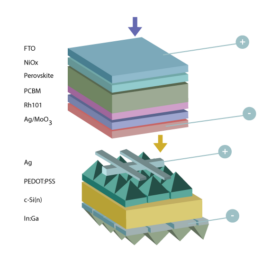
Indian scientists build 4T perovskite-silicon tandem cell based on hybrid heterojunction PV device
A research group in India has embedded a hybrid heterojunction solar cell as a bottom device in a four-terminal perovskite-silicon solar cell using a solution processing technique. The novel cell architecture, according to its creators, could be produced at significantly lower costs compared to conventional perovskite-silicon tandem designs.
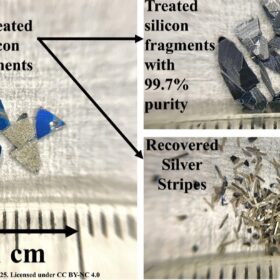
UNSW develops PV panel recycling method that recovers cell metals for upcycling
UNSW researchers were able to recover silicon from end of life solar PV panels pure enough for re-use in silicon carbide-based devices. Their novel multi-step method which includes thermal and chemical processes, also recovers silver.
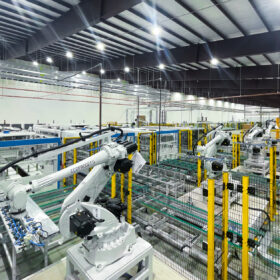
Ecoprogetti supplies US solar panel maker with 800 MW production line
Ecoprogetti has supplied US solar manufacturer CS Solar MFG LLC with an 800 MW production line to produce bifacial glass-glass passivated emitter rear cell (PERC) panels with over 22% efficiency.
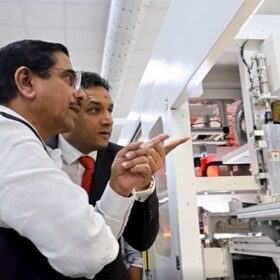
Goldi Solar launches AI-powered solar manufacturing line
Goldi Solar has opened a PV module manufacturing line, powered by automated optical inspection (AOI) and artificial intelligence, at its Kosamba factory in India.
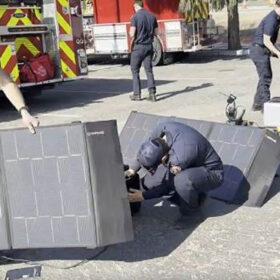
Rebuild fire-devastated homes all-electric with solar
Stanford University professor Mark Z. Jacobson explains how the areas of Los Angeles that were recently hit by fire have now the opportunity to reduce energy bills and reconstruction costs by rebuilding only all-electric homes. “There is no reason to have both electricity and fossil gas in a building at the same time. There is nothing gas does that electricity doesn’t do better,” he states.
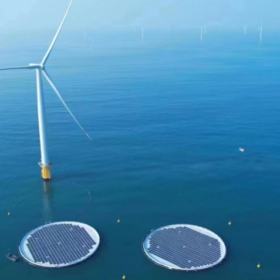
New method to identify best locations for offshore hybrid PV-wind projects
Scientists in Spain have created a new index that reportedly help project developers identify better areas in initial stages of hybrid wind-solar power plants development. The proposed approach is claimed to avoid deficiencies of previous criteria and overestimation caused by time delays.

Sun-tracking photovoltaics for stadiums
Researchers in Italy have developed a sun-tracking PV system design for stadium covers. The proposed approach is said to offer both strong structural response and high energy yield compared to systems based on fixed structures.
