
Takamiya launches vertical mounting solution for agrivoltaics, areas with little space
The Japanese company said its new vertical mounting system is ideal for farmland, regions with heavy snowfall, along factory fences, and in parking areas.

Chinese PV Industry Brief: DMEGC posts gains as peers hit by weak Q1
Chinese solar manufacturers have reported mixed first-quarter results. DMEGC recorded strong growth while peers such as HiUV, Risen, Autowell and Jolywood suffered sharp declines amid falling prices and oversupply.
Almaden plans solar glass factory in UAE
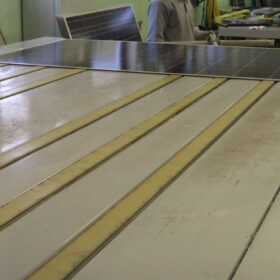
China’s Almaden says it will build a solar glass plant in the United Arab Emirates with an annual capacity of 500,000 tons, in line with its plans to globally expand as domestic profits fall.

Fraunhofer ISE streamlines use of epitaxial wafers in TOPCon solar cell manufacturing
Researchers at the German research institute have demonstrated that the so-called EpiWafers could be used directly for solar cell fabrication without needing a pre-gettering step. Their experiments provide a proof of principle* for epitaxially grown silicon wafers from German wafer manufacturer NexWafe GmbH.

Vikram Solar launches 630 W n-type bifacial modules
The Indian solar manufacturer has launched its Hypersol series panel series with power output from 605 W to 630 W and efficiency between 22.38% and 23.30%.

Reliance Industries switches on GW-scale heterojunction PV module line
Reliance Industries has begun production at the first phase of its planned 10 GW solar module facility. The fully automated line manufactures heterojunction (HJT) panels with outputs of up to 720 W.

Longi expresses interest in solar manufacturing in Algeria
A delegation from Chinese module maker Longi met with officials from Algeria’s Ministry of Energy and Mining last week to discuss cooperation that would support Algeria’s domestic solar market, including a solar manufacturing facility.
U.S. startup offers new solar cell copper metallization paste
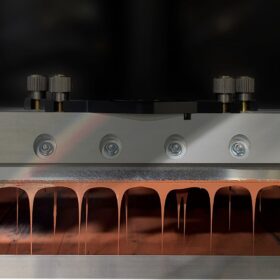
Bert Thin Films has developed a copper paste for solar cell manufacturing that keeps the copper from oxidizing during the air-firing process while at the same time avoiding it to make direct contact with the silicon. The new product can be used in existing production lines and with different cell configurations.

Top cell transparency remains critical challenge for tandem solar cells
New research from Germany has shown how improving top-cell transparency and performance remains key to the commercialization of tandem perovskite-silicon solar cells, as well as for all other types of tandem devices. The analysis demonstrated, in particular, that the top cell must achieve higher single-cell efficiency to compensate for reduced transparency.
Chinese PV Industry Brief: Polysilicon, solar module prices continue to slide
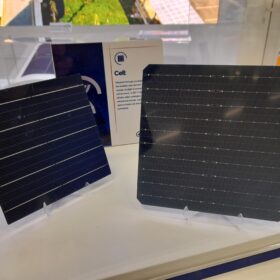
Polysilicon prices fell again this week amid weak market activity and elevated inventories, according to industry sources. Downstream wafer, cell, and module prices also continued to slide, with modules now trading as low as CNY 0.68 ($0.09)/W.
