
Solarium commissions 1 GW solar module plant in India
Rooftop solar company Solarium Green Energy has commissioned a 1 GW solar module manufacturing facility in Ahmedabad, Gujarat, producing large-format G12 modules up to 725 Wp and serving both internal and external customers.
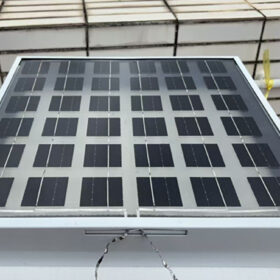
Thermochromic bifacial PV glazing system for reducing building cooling loads
Researchers in Hong Kong Hong Kong fabricated a thermochromic bifacial photovoltaic glazing system prototype that passively regulates solar heat gain while harvesting energy from both sides. Experiments and simulations showed it significantly reduces cooling loads and indoor temperatures while boosting electricity generation.

Japan publishes new guidelines for flexible solar cell installations
Japan’s New Energy and Industrial Technology Development Organization (NEDO) says its new design and construction guidelines for flexible PV and perovskite solar installations will help ensure the safety and reliability of systems deployed on low-load rooftops and wall surfaces where conventional panels cannot be installed.
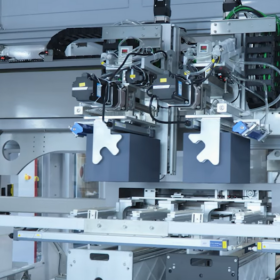
India’s PV module manufacturing capacity tops 210 GW
India added 119 GW of solar module capacity and over 9 GW of cell capacity in 2025, bringing total capacities to about 210 GW and 27 GW, respectively, according to Mercom India. Growth was driven by strong project demand and policy support, although supply-demand alignment is expected later in 2026 as domestic cell production ramps up.

France selects six operators for PV module recycling capacity
France’s solar recycling body has selected Envie 2E, Galloo, Rosi, RVE, and First Solar to manage rising volumes of end-of-life panels, with combined capacity exceeding 45,000 metric tons (MT) per year.
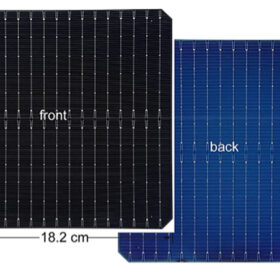
Discovery of passivating pinholes in TOPCon solar cells paves the way for higher efficiencies
DAS Solar and Hebei University have identified two types of pinholes in TOPCon solar cells: harmful recombinational pinholes, which lack oxygen and cause carrier recombination, and beneficial passivating pinholes, which retain oxygen to enable efficient tunneling while maintaining interface passivation. Their work shows that optimizing oxide layer formation, back-surface polishing, and polycrystalline silicon deposition can increase passivating pinholes, boosting device efficiency and guiding industrial cell design.

RenewSys inaugurates 3 GW solar module plant in India
RenewSys India has opened a 3 GW automated solar module facility in the Indian state of Maharashtra, expanding total module capacity to 5.6 GW.

DMEGC launches 475 W full-black solar module
The Chinese manufacturer said its new rooftop solar module offers 455–475 W power, 22.8–23.8% efficiency, 96-cell double-glass design, and IP68 protection.

Dutch startup plans roll-to-roll factory for perovskite solar cells
TNO has launched Perovion Technologies to industrialize lightweight, flexible perovskite solar cells, targeting niche applications where conventional panels are unsuitable. The company plans to build the first roll-to-roll perovskite solar cell manufacturing facility in the Netherlands by 2030.

Arctech presents dry cleaning robot weighing just 38 kg
The Chinese manufacturer said its new Star Shine I system is already available in Europe and can operate at speeds of 10–18 m/min, performing cleaning routes of up to 3 km round trip and 9 km in a single direction.
