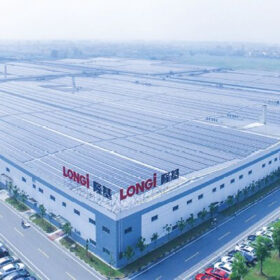
Longi denies rumors about factory closures in Southeast Asia
Chinese manufacturer Longi says it is not shutting down its factory in Malaysia, nor it is idling its production lines in Vietnam, but it acknowledges that it is implementing production adjustments at these facilities.

French roofing specialist offers adhesive solar modules for low-load bearing roofs
France-based Iko is launching Iko Excel Solar, a lightweight PV solution for roofs that cannot withstand excessive loads. The 18.3%-efficient module weighs approximately 2.5 kg/m².

Perovskite solar cell modified with potassium trifluoromethanesulfonate achieves 23.96% efficiency
A Chinese research team has modified the absorber of a conventional perovskite solar cell with potassium trifluoromethanesulfonate (KTFS) and found that the additive improved the device performance and stability. The cell’s perovskite film reportedly showed less lead defects and lower J-V hysteresis.
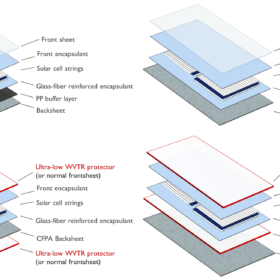
Lightweighting vehicle-integrated photovoltaic modules
A European research team has investigated interconnection and encapsulation strategies to improve the damp heat and mechanical resilience of vehicle integrated photovoltaic (VIPV) modules, finding carbon-fibre reinforced plastics to be promising.

PVEL releases tenth edition of ‘PV Module Reliability Scorecard’
The independent test lab Kiwa PVEL names 53 manufacturers and 388 models–a record number of Top Performers in the ten-year history of the Scorecard.
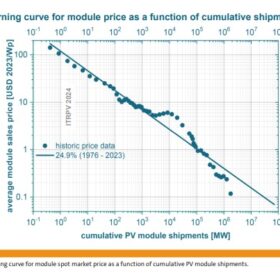
ITRPV says solar module prices fell 50% in 2023
The new edition of the International Technology Roadmap for Photovoltaic (ITRPV), published this week, reveals that the world’s installed PV capacity reached 1.6 TW at the end of last year. The learning curve, which reflects average module prices relative to cumulative shipments, is 24.9% for the period from 1976 to 2023.

Freight costs edge toward pandemic levels, hitting solar module costs
Freight costs, which represent around 4% of a solar module’s total costs, are increasing on trade lines between the Far East and the US West Coast, Northern Europe, and Mediterranean region.
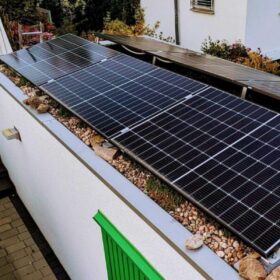
German startup offers plug-and-play 2.46 kW PV system
Wattando has developed a new rooftop PV solution that can be easily connected to a household’s power network via an AC connection. The system uses existing infrastructure and reportedly reduces installation work and time.
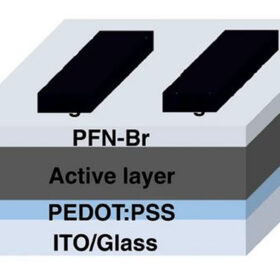
Organic solar cell based on trichlorobenzene achieves 19.31% efficiency
An international research team developed an organic solar cell based on a novel non-monotonic intermediated state manipulation strategy. The device reportedly showed non-radiative recombination losses while exhibiting remarkable power conversion efficiency.

Circular recycling approach aims for ‘perpetual utility’ of PV materials
After analyzing the future usage of material by the crystalline silicon PV industry, including glass, aluminum, silver, copper, ethylene-vinyl-acetate (EVA), and silicon, a German research team found that a circular recycling approach could address foreseeable supply problems. It could also reportedly become economically sustainable.
