
Hanwha Qcells shuts down 3.5 GW solar factory in South Korea
Hanwha Qcells has closed its 3.5 GW solar factory in South Korea as part of plans to optimize its PV module production capabilities amid a stagnant domestic solar market.

Workflow for integration of BIPV in historical buildings
Italian researchers have outlined a four-step method to assess the technical feasibility of building-integrated PV (BIPV) projects in historical buildings. They applied the proposed approach to a courtyard building from the 16th century in the historical Italian town of Marcianise.
Imec integrates silicon heterojunction solar cells into curved surfaces
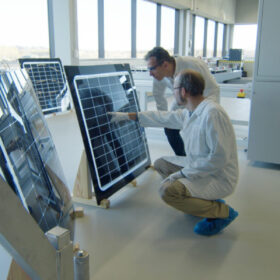
Imec has successfully integrated silicon heterojunction PV cells into curved surfaces, resulting in a 6% efficiency increase compared to passivated emitter and rear contact (PERC) half cells. The cells are suitable for applications in vehicle-integrated and building-integrated PV (BIPV).

Are Europe’s major solar associations divided, again?
An article published in French newspaper Le Monde recently sparked a war between two prominent European PV associations – the decades-old SolarPower Europe and the three-year-old newcomer the European Solar Manufacturing Council. pv magazine looked into the matter to unpick the potential long-term impact the rift could have on the sector.

France’s INES building first TOPCon panels for space applications
France’s National Solar Energy Institute (INES) – a division of the French Alternative Energies and Atomic Energy Commission (CEA) – is developing ultra-thin TOPCon solar devices for space missions, in cooperation with the European Space Agency (ESA).
GCL claims 18.04% efficiency for perovskite solar panel
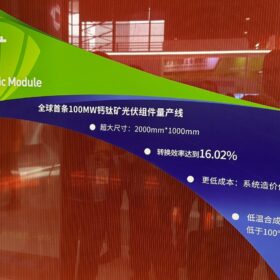
The China National Institute of Metrology has certified the result. The manufacturer claims it was able to increase the panel efficiency from 16.02% to 18.04% in a few months.
New solar installations to hit 413 GW this year, says BloombergNEF
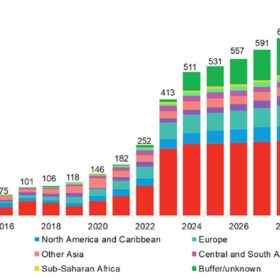
BloombergNEF says historically low module prices will drive the global solar industry to record installations in 2023.

Chinese PV Industry Brief: CHN Energy buys 10 GW of solar modules at $0.15/W
CHN Energy has acquired 10 GW of solar modules at $0.15/W in its most recent solar module procurement round. The state-owned company says it bought 3.21 GW of panels from Longi, 740 MW from Tongwei, 2.49 GW from Astronergy, and 3.56 GW from JinkoSolar.
India’s Waaree secures US order for 1.5 GW of TOPCon solar modules
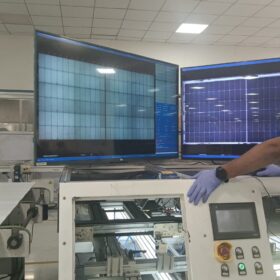
India’s Waaree has signed a three-year deal with Acciona to supply 1.5 GW of TOPCon solar modules for the Spanish developer’s PV installations in the United States from 2024 to 2026.

Renewables helping China to halve power prices compared to US, Europe
Wood Mackenzie says in a new report that China could install 230 GW of PV and wind capacity and export more than 200 GW of solar panels in 2023. Unlike Europe and United States, the country is avoiding the high curtailment of PV and wind.
