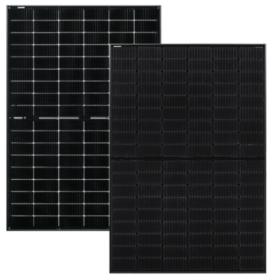
Bauer Solar introduces 440 W glass-glass solar modules
Bauer Solar is expanding its “Premium Protect” series with its new 440 W glass-glass solar modules. Since the beginning of December, the German PV manufacturer has only offered glass-glass modules.
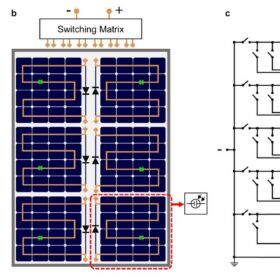
Reconfigurable series-parallel photovoltaic modules with high shading tolerance
TU Deflt researchers made a first attempt to validate reconfigurable solar modules using prototypes in outdoor tests. The panels consist of two or more blocks of solar cells that are connected to a switching matrix and reportedly achieve a 10.2% higher energy yield than conventional shade-resilient modules under partial shading conditions.
Weekend Read: Europe’s subsidy conundrum
On Nov. 6, the European Solar PV Industry Alliance (ESIA) published a recommendation paper in which it set out how its members envisage a European support scheme to foster the development of European solar. What chance does it have of actually achieving its goals? Götz Fischbeck delivers an assessment.
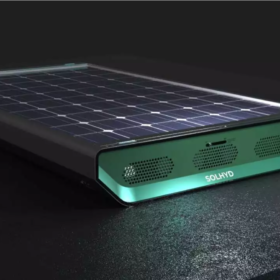
KU Leuven spinoff plans MW-scale production of solar-hydrogen panels
Solhyd, a KU Leuven spinoff, is refining its technology to reach megawatt-scale production of hydrogen-producing solar panels with a €6 million ($6.5 million) investment from a consortium of Flemish investors.
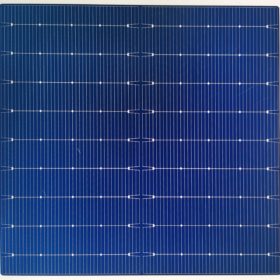
Chinese PV Industry Brief: Polysilicon prices continue to fall
Polysilicon prices fell by as much as 0.63% in China this week, according to the China Nonferrous Metals Industry Association (CNMIA).
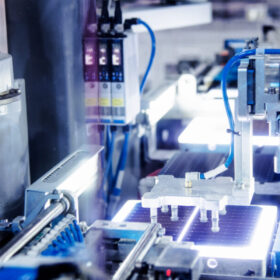
Energetica Industries files for insolvency
Energetica Industries, an Austrian PV manufacturer, can no longer meet its payment obligations. A total of 120 creditors and 94 employees are affected by the insolvency proceedings.
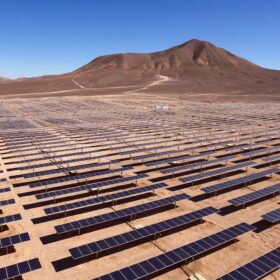
Solar LCOE now 29% lower than any fossil fuel option, says EY
A report from Ernst & Young (EY) shows that despite inflationary pressures, solar remains the cheapest source of new-build electricity. The global weighted average levelized cost of electricity (LCOE) for PV is now 29% lower than the cheapest fossil fuel alternative.
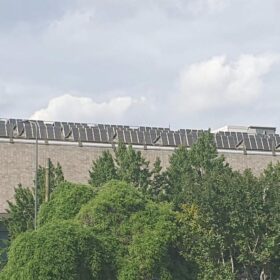
Exploring the depths of Italy’s oldest BIPV project
Scientists have assessed the performance of Italy’s first publicly funded BIPV project, which was installed in 2001. Their analysis shows that only one of the 10%-efficient panels in the 11 kW array experienced a severe fault that caused the complete loss of functionality.

MIT researchers plan to use acenes to make singlet fission solar cells
Acenes are benzene molecules with unique optoelectronic properties. Singlet fission solar cells can produce two electrons from one photon, making the cell more efficient.
New research identifies advantages of POE encapsulants in dual-glass solar modules
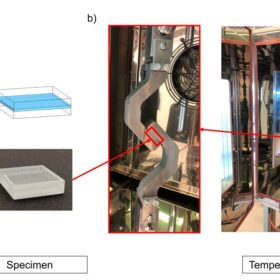
To understand better the long-term effects of humidity on durability of glass-glass modules, Austrian researchers carried out lengthy damp-heat tests on double glass modules made with EVA and POE encapsulants. They identified several POE advantages, such as improved interfacial strength and less water uptake, among others.
