
Autonomous photovoltaic vehicle Infinite Apollo validates urban circulation performance
In late April, a 200 km urban road test was conducted in Belgium under real-world traffic conditions and varying levels of solar irradiance to evaluate system performance in complex operational environments. The test serves as the final validation of the vehicle’s systems.
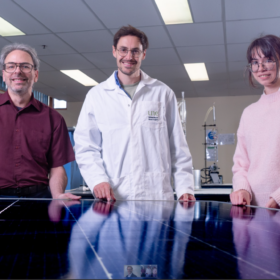
Australian researchers accelerate silicon wafer recycling using AI, robotics
Scientists from the University of New England’s Australian Institute for Strategic Artificial Intelligence are using artificial intelligence and powerful supercomputers to assess potential solvents to separate silicon wafers with minimal contamination.
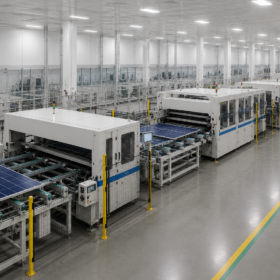
Texas PV module production to exceed 15 GW in 2026
Propelled by a select group of high-capacity manufacturers including T1 Energy and Canadian Solar, Texas is set to exceed 15 GW of solar PV module production in 2026, accounting for nearly half of all U.S. silicon-based manufacturing and serving as the primary hub for the inaugural Solar Manufacturing USA conference in Austin this September.
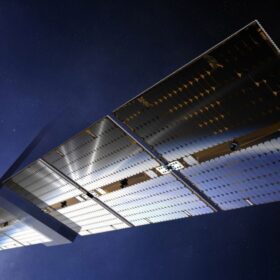
Dutch partners explore bringing silicon PV into space
The Netherlands Organization for Applied Scientific Research (TNO) is working with solar manufacturer MCPV and aviation giant Airbus to adapt terrestrial-proven silicon technology for space operations. It is envisaged the technology could serve as a lower-cost alternative to the gallium arsenide solar cells used in most space solar arrays today.
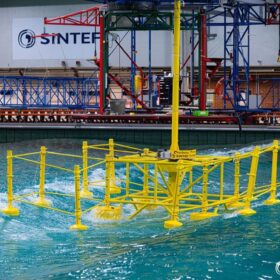
Norwegian startup testing hybrid solar, wave, wind system
Norway’s Flex2Future has begun testing a scaled-down model of its offshore energy system in collaboration with research firm SINTEF. The startup’s CEO says the system, integrating solar, wave and wind energy, can deliver power at a relatively low cost per kWh.

PV module recycling technologies ‘progressing’, says IEA-PVPS
Latest report from the International Energy Agency’s (IEA) Photovoltaic Power Systems Programme (PVPS) finds measurable advancements in PV module recycling performance compared to its prior studies, including higher material recovery rates, improved process yields and higher output purity.
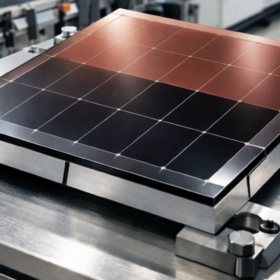
Fraunhofer ISE opens perovskite-silicon tandem scale-up lab
Fraunhofer Institute for Solar Energy Systems ISE has opened a dedicated lab in Freiburg, Germany, to scale perovskite-silicon tandem cell designs to large wafer formats using industry-standard processes.
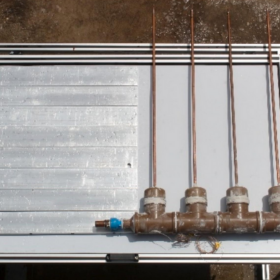
How to retrofit commercial PV panels into photovoltaic-thermal modules
Researchers in Brazil found that retrofitting commercial PV panels into PVT systems can boost total efficiency to around 46–50%, but added thermal resistance limits heat extraction and slightly reduces electrical performance. Their experiments showed performance is capped by interface quality and system design, requiring improved heat extraction capacity.
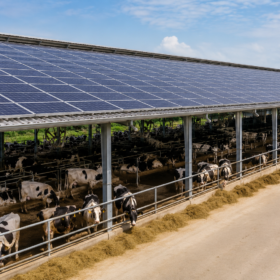
Solar panels reduce thermal stress in dairy barns during critical afternoon hours
A study from China shows rooftop PV systems on dairy barns can significantly reduce roof heat flux and improve indoor thermal conditions. Field measurements and simulations found up to a 2.3 C reduction in indoor temperature during peak afternoon heat stress periods.
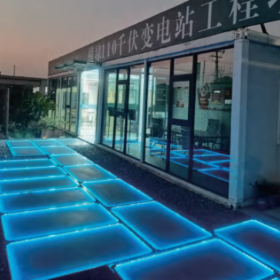
Arctech debuts TOPCon photovoltaic pavement solution
Harmony-F solar flooring can withstand uniformly distributed loads of at least 2 tons and has a hardness above 7 on the Mohs scale, indicating high resistance to wear and abrasion.
