
Rescue bid for German solar glass maker GMB fails
The solar glass manufacturer started insolvency proceedings in July. An investor’s bid has now failed, leaving over 200 employees facing layoffs.

Japan pilots low-weight solar panels, perovskite windows for buildings
Mitsui Home and Tokyo Gas have revealed plans to deploy Japan’s first combined on-site and virtual solar power purchase agreement (PPA), cutting factory emissions and maximizing rooftop energy use.

N-type wafer prices extend four-week slide amid weak demand, rising inventory concerns
In a new weekly update for pv magazine, OPIS, a Dow Jones company, provides a quick look at the main price trends in the global PV industry.
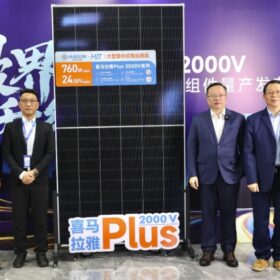
Huasun unveils 770 W, 2,000 V heterojunction solar module
The Chinese manufacturer said the higher-voltage design of the new module reduces cable, combiner, pile-foundation, and land-use requirements, delivering balance-of-system savings of up to CNY 0.15 ($0.012)/W in western China. The module offers a power output of 730 W to 770 W and a conversion efficiency of up to 24.8%.
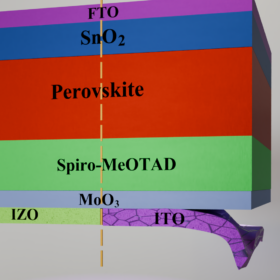
Highly transparent perovskite solar cell achieves 18.22% efficiency
A research team in India has investigated the use of highly conductive transparent electrodes based on amorphous indium zinc made with a room temperature process in perovskite solar cells. The devices could be used in tandem and building-integrated PV applications.

JinkoSolar achieves world record efficiency of 27.79% for TOPCon solar cell
The Chinese manufacturer says Germany’s Institute for Solar Energy Research Hamelin (ISFH) has independently verified the result.
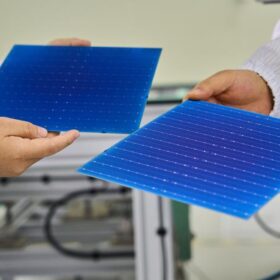
New research sheds light on passivation-related defects in heterojunction solar cells
Korean researchers revealed that efficiency losses in heterojunction solar cells arise from two coexisting defect types – dangling bonds and weak silicon-silicon bonds. Their findings explain how hydrogenated amorphous silicon passivation help mitigate these defects and improve cell performance.

India’s Vikram Solar commissions 5 GW automated module plant
Vikram Solar says its new 5 GW Vallam facility in Tamil Nadu lifts its module manufacturing capacity to 9.5 GW and is built on tunnel oxide passivated contact (TOPCon) technology with future heterojunction upgrades.

Spanish researchers developing rear-side concentrated PV modules for agrivoltaics
Researchers at University of Jaén in Spain have demonstrated a semi-transparent crystalline silicon solar photovoltaic module with rear-side optical concentrators for agrivoltaics applications.

European solar manufacturing ‘considerably behind’ NZIA targets, says EU observatory
A report from the Clean Energy Technology Observatory finds that while the EU is a technology leader in PV inverters, trackers and mounting structures, its manufacturing capacity in solar ingots, wafers, cells and modules falls far behind targets set by the Net Zero Industry Act.
