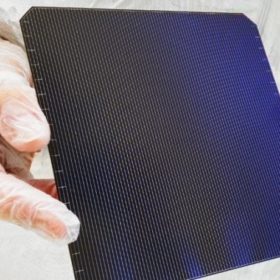
French scientists discover new UV-induced degradation pathways in heterojunction solar cells
Scientists from French research institute CEA-Liten have identified hydrogen migration in doped selective layers as the primary driver of UV-induced degradation in silicon heterojunction solar cells. They have also found that combined light and thermal light-soaking treatments can partially restore performance and improve long-term UV stability.

Australian startup moves forward with perovskite solar manufacturing plans
Halocell Energy is set to benefit from the development of a sovereign supply chain for high-purity precursors to perovskite after signing a memorandum of understanding with Queensland advanced materials company Lava Blue.

Scientists achieve 32.6% efficiency in perovskite-silicon tandem solar cell via interface engineering
Researchers from KAUST, TU Delft, and LMU Munich have improved the performance of monolithic perovskite-silicon tandem solar cells by modifying the physical structure at the front of the bottom heterojunction solar cell.

Japan’s solar industry targets vertical bifacial PV with new guide
The Japan Photovoltaic Energy Association (JPEA) has released a voluntary reference guide to support adoption of vertical bifacial PV in Japan, outlining design, performance, and compliance considerations for projects in snow-prone, high-latitude, and space-constrained conditions.
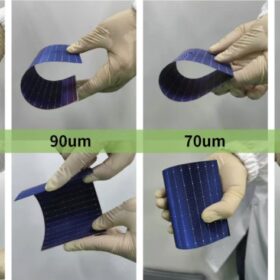
Ideal Energy commissions AI-enabled flexible HJT pilot line for space
China-based PV equipment supplier Ideal Energy (Shanghai) Sunflower Semiconductor has completed an AI-enabled pilot line for ultra-thin, flexible heterojunction (HJT) solar cells, targeting lightweight power systems for space and near-space applications.
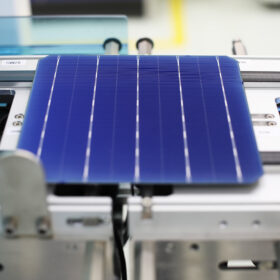
More PV manufacturers expected to adopt copper metallization in 2026
Rising silver prices are pushing PV manufacturers toward copper-based metallization, with DK Electronic Materials targeting 2026 for large-scale deployment of high-copper paste solutions, while Fraunhofer ISE warns efficiency trade-offs remain unacceptable.
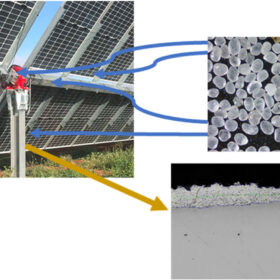
The impact of sand erosion on mounting structures in large-scale PV plants
Researchers in Spain have tested the erosion resistance of common galvanized coatings using both free-falling sand and forced-air sand-impingement methods. The study found that continuously galvanized steel coatings showed the lowest erosion rates, outperforming HDG and Zn-Al-Mg coatings.

First Solar wins key round in TOPCon patent dispute
The U.S. federal patent office rejected separate challenges from JinkoSolar, Canadian Solar and Mundra Solar to invalidate intellectual property that First Solar claims is fundamental to the manufacturing of crystalline silicon solar cells.

Omani polysilicon factory reaches financial close
United Solar Holding has secured more than $900 million to complete the financing required for its 100,000 MT polysilicon manufacturing facility in Oman. Production is expected to begin during the first quarter of this year.

Key takeaways from Abu Dhabi’s World Future Energy Summit
WFES 2026 in Abu Dhabi underscored growing momentum for solar, storage, and C&I renewables across MENA, with batteries emerging as a key enabler for grid stability, agriculture, and data centers. Industry leaders pointed to Iraq, Libya, Yemen, and Saudi Arabia as key growth markets, highlighting rising interest in AI-driven data centers, solar-plus-storage solutions, and a broadening regional supply chain.
