
USA Roundtables 2021 live blog: Thank you for attending!
Join pv magazine and solar industry leaders as we meet for the USA Roundtables 2021 today, from 10:00 AM to 5:00 PM EST.
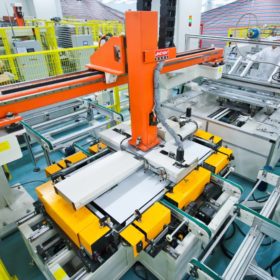
Chinese PV Industry Brief: Two major deals for PV production equipment
JSG has sold several ingot furnaces to Shuangliang Eco-Energy and Jinchen Machinery will provide Yingli with production equipment totaling 3.5 GW.
Gallium arsenide nanowire solar cell with 7.7% efficiency
Norwegian scientists have developed a gallium arsenide (GaAs) nanowire solar cell that can be used as a top cell in a dual tandem cell with a bottom silicon cell. The device is claimed to be the most efficient single-junction GaAs nanowire solar cell grown on a silicon substrate so far.
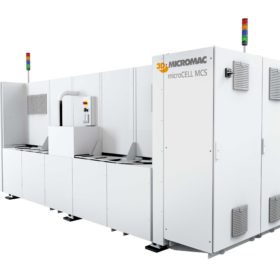
New laser-cutting system for half-cut, shingled PV cells
German manufacturer 3-D Micromac said it has developed a new machine that can produce more than 6,000 wafers per hour. It is suitable for solar cells with temperature-sensitive coatings, or depositions such as heterojunction devices.
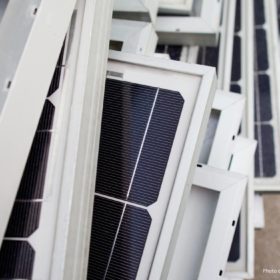
End-of-life management of solar PV waste in India
A new study proposes an ‘extended producer responsibility’ regulatory framework for end-of-life solar PV management in India.
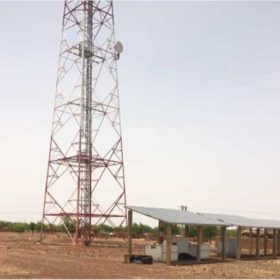
How PV performs close to radio, TV antennas
Researchers in Kenya have analyzed the performance of an off-grid PV system located near an isotropic antenna as an emitting source.
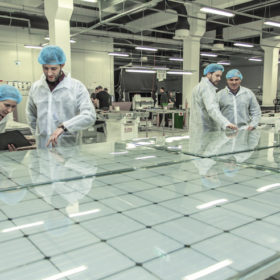
Lithuanian module maker says European and US clients moving away from Chinese supply chain
Vilnius-headquartered Solitek is preparing to ramp its output next year on the back of rising orders in Scandinavia, and says its new partnership with New York-based Convalt Energy will reduce its dependence on Asian semiconductors and solar cells.
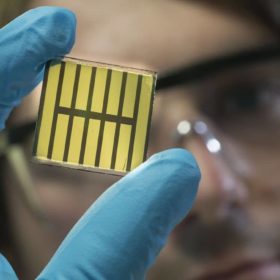
Established thin film processing for 18%-efficient perovskite mini-modules
Scientists in Germany applied vapor-based deposition techniques and laser scribed interconnection – both well established processes in existing thin-film solar manufacturing – to fabricate perovskite mini modules. The group achieved a maximum efficiency of 18% for a device measuring 4cm². Relying on these processes, they say, could simplify processing and reduce losses associated with scaling up to commercial-sized devices.
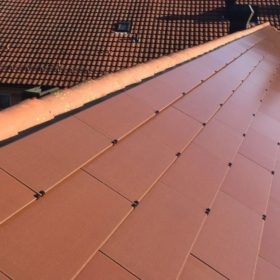
Solar tile with anti-glare coating from Switzerland
Swiss manufacturer Megasol said the new product is compatible with the most common tile formats and also available in different colors. Megasol has also developed a coating that eliminates the glare effect of solar modules.

Handheld dry-cleaning tool for solar modules
The handheld, cordless cleaning tool is a cost-effective and efficient alternative to automated cleaning robots that are usually limited in operation by panel inclination.
