
Tesla now claims ‘lowest price for home solar’ – but process is ‘full of pitfalls’
Tesla has decimated its solar business from installation peaks of years past and its market share lead has long been surrendered to Sunrun and others. In December, it claimed it would install 1,000 building-integrated solar roofs per week – a figure it has not come close to achieving in six months. Is this any way to run a solar business?
The weekend read: Pirates of the PV industry
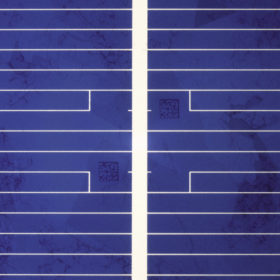
Product piracy is a well-known threat in many industries, and in solar the risk posed by poor quality products from disreputable manufacturers making their way onto rooftops and other PV installations should not be underestimated. With manufacturers investing in solutions to protect against inferior products bearing their logo, pv magazine looks at the size of the problem.
Chinese PV Industry Brief: 3 GW of panel procurement, new PV glass capacity
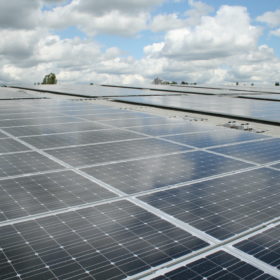
Seven PV module manufacturers – including JinkoSolar, Longi and JA Solar – won supply contracts this week in a 3 GW procurement round held by China National Nuclear Corp. Flat Glass revealed plans to raise $282.6 million to expand production, while the National Energy Administration reported growth in the residential PV segment.
Meyer Burger moves to become a solar cell and module manufacturer
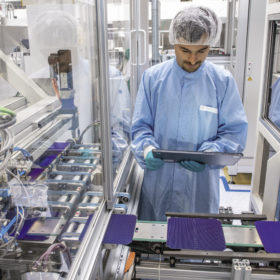
Through a CHF165 million capital increase, the Swiss company intends to finance the expansion of capacities for highly efficient solar cells and solar modules in Germany. Production is scheduled to start next year. The strategic partnership with REC Group has been discontinued.
New production equipment for large-area perovskite solar cells
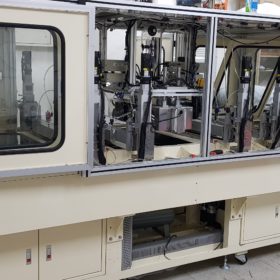
National Taiwan University and Taiwanese PV production equipment provider E-Sun Precision Industrial Co. have developed equipment to produce different kinds of perovskite cells with varying chemical compositions. The first trials achieved 14.3% conversion efficiency rates.
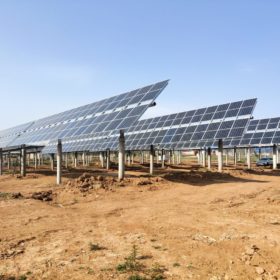
Trina Solar launches TrinaPro Mega ultra-high-power PV solution
As the solar industry starts to embrace ultra-high-efficiency modules, the Chinese PV heavyweight has unveiled TrinaPro Mega, the first integrated solar system in the world that incorporates 500 W+ modules.
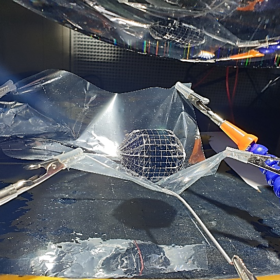
Spherical monocrystalline solar cells with 18.93% efficiency
The spherical 3D cells can reportedly generate around 101% more power than conventional flat solar cells. Measurements have also shown that the spherical cells provide a 10% lower maximum temperature compared to flat cells, while accumulating less dust.
US module shipments spiked in quantity, plunged in price amid pandemic
Manufacturers shipped about 2.05 GW of PV modules in March, before plummeting to 1.24 GW in April. But while shipments slowed, the cost per watt peak reached a record low.

Hanwha Q-Cells wins patent litigation against JinkoSolar, REC Solar and Longi in Germany
The Düsseldorf Regional Court has agreed rivals of the Korean manufacturer illegally used its patented passivation technology. The judges granted Hanwha Q-Cells an injunction which requires Jinko, REC and Longi to retrieve all modules featuring the patented technology distributed in Germany since late January last year. Hanwha can also opt to have the offending products destroyed.

Scientists in China give flexible perovskites a backbone
A team of researchers led by Nanchang University in China trialed a polymer based hole transport layer to flexible perovskite solar cells, using a glue to attach it to the active perovskite. The team was able to assemble the 19.87%-efficient cells into a small flexible module suitable for wearable solar applications, and says its design was inspired by the structure and movements of human vertebrae.
