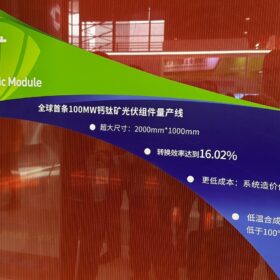
GCL claims 19.04% efficiency for perovskite solar panel
The Chinese manufacturer was able to increase the panel efficiency from 18.04% to 19.04% in 16 months. The panel has a size of 2,005 mm x 1,005 mm x 35 mm and a weight of 34.5 kg.

MCPV secures €10 million grant for 2.5 GW solar module factory in Spain
Netherlands-based MCPV, a silicon heterojunction PV manufacturer, is planning to build a GW-sized PV panel factory in Tudela, Navarra, Spain.
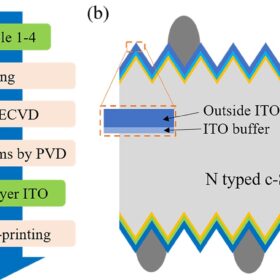
Heterojunction solar cell based on indium tin oxide buffer layer achieves 25.36% efficiency
Researchers in China have sought to increase the efficiency of heterojunction solar cell through a buffer layer made of indium tin oxide. This innovation reportedly resulted in a 0.1% efficiency increase deriving from optimized short-circuit current density and fill factor.

Two U.S. solar production projects out of commission
SPI’s panel-manufacturing plant in California has suddenly ceased operation and its cell-production site in South Carolina never got off the ground.

Nigeria proposes ban on solar panel imports
The Nigerian government plans to ban solar panel imports to boost domestic production, but the Centre for the Promotion of Private Enterprise, a Lagos-based consultancy, warns the country is unprepared for such a restriction.

Astronergy to build $500 million solar cell factory in Turkey
Astronergy says it plans to invest $500 million in a solar cell factory in Turkey, expanding its presence beyond its existing 850 MW module assembly facility.

PV-driven self-insulating composite exterior wall panel for building applications
Scientists in China have designed a solar self-insulated composite exterior wall panel, integrating a solar collector panel, PV panel, and insulation board. The proposed experimental setup has reportedly a static payback period of 1.1 years.

Myanmar earthquake disrupts solar wafer production, global supply chain
The recent 7.7-magnitude earthquake in Myanmar has disrupted solar wafer production in western China, where about 50% of the country’s wafer capacity is concentrated. Major manufacturers have suspended operations due to equipment failures, raising concerns over supply shortages and higher global solar prices.

India reaches 74 GW of solar module capacity
India’s solar module manufacturing capacity nearly doubled from 38 GW in March 2024 to 74 GW in March 2025. PV cell manufacturing capacity tripled from 9 GW to 25 GW.
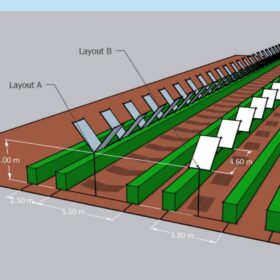
V-shaped PV system for agrivoltaic applications
An Italian startup supported by a group of scientists is developing a V-shaped agrivoltaic system that can reportedly find optimal application with bifacial modules and single-axis tracking. The proposed system configuration is claimed to reduce land use by 24 % compared to conventional setups.
