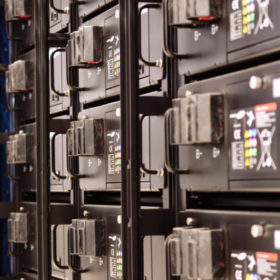
Innogy announces 60 MW storage project in Ireland
Several large utility-scale storage projects have already been developed under Ireland’s DS3 program. Innogy says that it now plans to look for more storage project possibilities in the country.
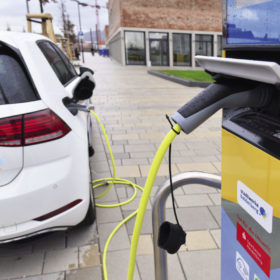
Indian companies to partner on EV charging infrastructure
State-owned Energy Efficiency Services and New Delhi-based Bharat Heavy Electricals have agreed to set up public charging stations for electric vehicles on highways across India.

For a bigger battery, just add manganese
Scientists at the University of Southern Denmark working with sodium-ion batteries found that a new electrode material incorporating iron, manganese and phosphorous could increase both the power and capacity of the batteries.

ERA-Net awards 23 future energy pilot projects across Europe
Under the umbrella of the European Union’s Horizon 2020 initiative, the research platform ERA has initiated a new batch of future energy projects. Looking at the list of winning projects, it is easy to tell that hydrogen, virtual power plant, and blockchain projects are really at the center of what Europe thinks will be important for its net-zero carbon plans by 2050.
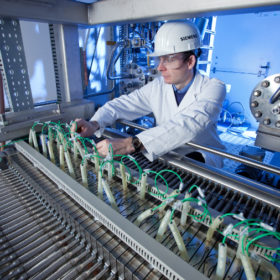
Integrated energy system could see 110 GW of electrolyzers in Germany and Netherlands
A report from Dutch grid operator TenneT and gas business Gasunie suggests the companies should jointly develop infrastructure after 2030. With hydrogen and synthetic methane in demand, electricity and gas will become increasingly inter-linked. Only seamless integration of the two networks would enable the EU to achieve its net-zero-carbon 2050 plan.

Navajo Nation land could host 2.2 GW pumped hydro storage station
The Federal Energy Regulatory Commission has accepted Daybreak Energy’s application to develop a 2,230 MW pumped-hydro facility on the banks of Lake Powell in Utah.

Solving seasonal storage with aluminum cycling
Scientists at Switzerland’s University of Applied Sciences Rapperswil have demonstrated an aluminum conversion process which could be valuable for long-term renewable energy storage. Simulations suggest that by employing the process, a new multi-family building in Switzerland could meet all its energy demand from a 7-11 kWp solar system.
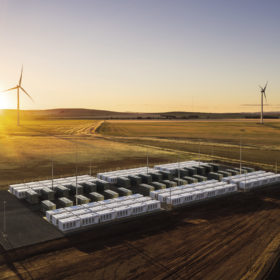
Lake Bonney big battery ready to supply Tesla’s Australian EV charger network
The 25 MW/52 MWh battery at the Lake Bonney wind farm is in the final stages of testing. Once operational, the big Tesla battery will supply the electric carmaker’s Australia EV supercharger network with renewable electricity.
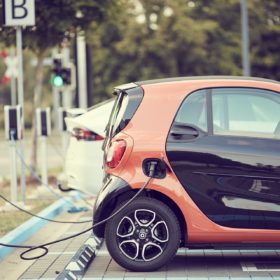
Total to deploy 20,000 EV charging stations in the Netherlands
The public charging points will be installed in the provinces of North Holland, Flevoland and Utrecht. The oil giant said they would all be powered by renewable energy.
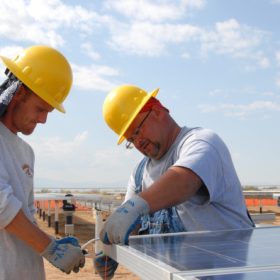
A clean energy world would support millions of new jobs
A study from Finland’s Lappeenranta University of Technology has predicted solar and other renewables can provide a global energy jobs revolution – just as four European operations revealed recent struggles.
