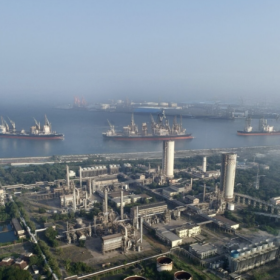
SECI sets new record with $0.59/kg green ammonia auction price
Solar Energy Corp of India (SECI) has discovered a new record-low green ammonia price of INR 51.8 ($0.59)/kg, or around $591.25 per metric ton, in its latest auction. The winning bid was placed by NTPC Renewable Energy Ltd.
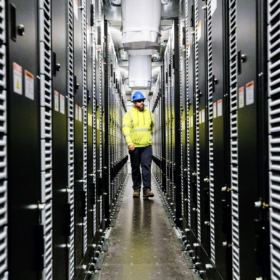
New York Power Authority doubles renewables target to 6.6 GW
The New York Power Authority has doubled the capacity target in its renewables plan to 6.6 GW after criticism that its initial 3.3 GW proposal fell short of state climate goals.
Sinovoltaics releases latest PV inverter manufacturer ranking
The quality assurance firm updated its inverter manufacturer financial stability ranking with APSystems (Yuneng Technology), Sinexcel, and Eaton in the top three spots.

Germany reduces feed-in tariffs for solar up to 1 MW
Germany has set new feed-in tariffs for solar systems up to 100 kW starting Aug. 1, ranging from €0.06327 ($0.073)/kWh to €0.1247/kWh, regardless of self-consumption.
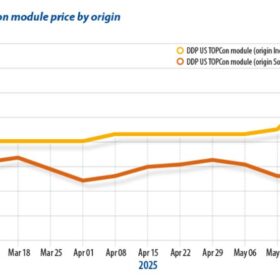
Trade headwinds fragment PV prices
Tempestuous trade conditions and policy uncertainty have led to module price fragmentation in the United States. Ahead of an expected reduction in manufacturing capacity utilization, leading manufacturers in China produced a high volume of cells in the spring. OPIS editorial director Hanwei Wu explains the latest market developments.

Uzbekistan certifies first solar plant under I-REC system
Uzbekistan’s Ministry of Economy and Finance has approved an 823 kW solar plant to begin trading International Renewable Energy Certificates (I-REC), marking the country’s fifth renewable energy project to join the scheme.

Italy deploys 2.33 GW of solar in H1
Italy added around 1,092 MW of new PV systems in the second quarter of this year, with the rooftop segment driving demand.

Utility launches solar tender in Philippines
Meralco, the only electric power distributor in Manila, has opened a tender for solar projects to be deployed across a number of its sites. The deadline for applications is Aug. 7.
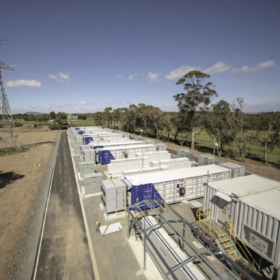
India set to add 30 GW of storage by 2027, outpacing demand forecast
India is projected to add 30 GW of new energy storage capacity by June 2027 through standalone and firm and dispatchable renewable energy (FDRE) projects, according to a recent report by SBI Capital Markets (SBICAPS). This could potentially push total capacity to 36 GW against 24 GW of estimated demand.

Double materiality assessment: Why rigorous ESG risk mapping isn’t optional anymore
Double Materiality Assessment (DMA) has become a central concept in Environmental, Social, and Governance (ESG) frameworks, especially under recent regulatory initiatives like the EU Corporate Sustainability Reporting Directive (CSRD). While implementation of DMA will only become mandatory for many companies over the next few years, there are already discussions at the EU commission in Brussels about simplifying the process to ease adoption. As an early adopter, Trinasolar shares insights on the purpose and benefits of DMA, makes a strong case for full-scope transparency, and reflects on key learnings from the 2024 DMA matrix rollout.
