Czechia approves new laws for agrivoltaics
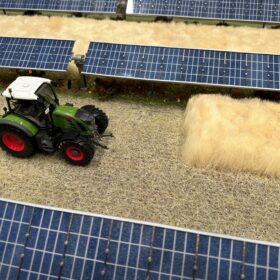
The Czech government has approved new legislation for agrivoltaics. The measures extend the amount of crop types that agrivoltaics can be deployed on and defines two categories of permissible agrivoltaic systems.
New rules allow VPPs to compete in Australia’s energy market from 2027
The Australian Energy Market Commission (AEMC) has released a final determination to allow virtual power plants (VPPs) to compete directly with large-scale generators in the energy market, scheduled to begin in 2027.

How to measure industry’s carbon footprint
The IEC has launched a new portfolio of carbon footprint verification services to help build trust and credibility in companies’ commitment to monitoring and reducing their emissions.
France awards 464 MW of 500 MW tech-neutral renewables tender to solar
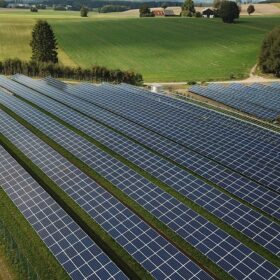
The French government has allocated 464 MW of the 500 MW available in a technology-neutral renewables tender to PV projects.

Hungary approves measures for solar on apartment buildings
Hungary has decided to allow apartment owners to jointly install solar panels and will only permit solar plants equipped with grid-connected inverters from July 2025.
Maltese scientists design offshore virtual power plant integrating PV, wind, storage
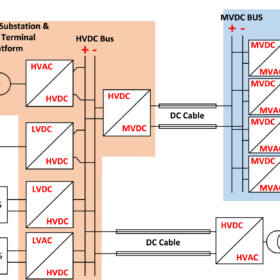
The proposed virtual power plant (VPP) integrates a platform-to-ship (P2S) setup to electrify anchored and bunkering ships, while also providing surplus electricity to the country’s grid. The system was designed to operate through a 200 MW floating wind farm and a 300 MW floating PV plant, with battery and compressed air systmes being used for energy storage.
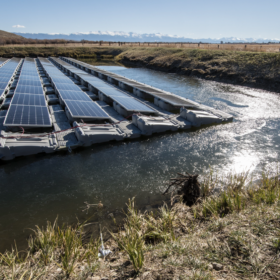
US reservoirs could host up to 1,042 GW of floating solar
Federally controlled reservoirs could generate 861 GW to 1,042 GW of floating solar power across the United States, according to a new study by the National Renewable Energy Laboratory (NREL).
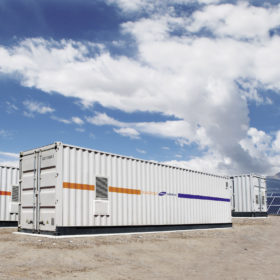
Puerto Rico receives US DOE loans to boost battery storage to 1 GWh
The U.S. Department of Energy (DOE) will provide more than half a billion dollars in loans to add nearly 1 GWh of capacity via Convergent, to build and operate utility-scale solar-plus-storage in Puerto Rico, improving grid resilience.

Taiwan maintains solar FITs to support residential PV deployment
Taiwan’s Ministry of Economic Affairs (MoEA) says its feed-in tariff (FIT) for PV systems up to 10 kW in size will be maintained at TWD 5.7055 ($0.17)/kWh, with the aim of further supporting homeowners and small businesses adopting solar.

‘Closing the gender gap is not just an ethical imperative but also a strategic one’
This week, Women in Solar Europe (WiSEu) gives voice to Ines Monroy, founder of Spain-based Licenciasocial.energy. She says the global renewable energy industry should be prepared to adress the so-called authority gap. “When I’ve adopted a neutral, professional tone to convey directives or focus on problem-solving, I’ve been met with comments suggesting that my approach was ‘bossy’ or ‘too harsh.’ My impression is that this reaction stems from ingrained stereotypes that expect women to be overly accommodating, even in roles where decisiveness and objectivity are critical,” she states.
