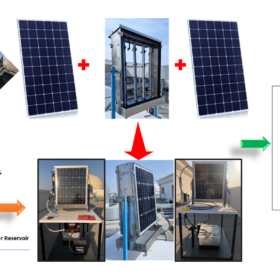
Cooling bifacial PV modules with mist
Scientists have placed mist nozzles inside a bifacial PV module and measured it under an extremely hot climate. The module was found to generate up to 37% more electricity on sunny days and up to 46% more on cloudy days compared to standard monofacial panels.
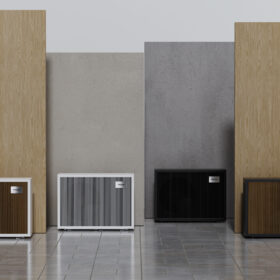
SolarEast debuts new residential propane heat pumps
The Chinese manufacturer said its new heat pump systems have a heating capacity of 4 kW to 16 kW and a coefficient of performance of up to 5.05.

World’s first offshore wind-solar project moves forward
An offshore solar farm is being deployed close to an existing wind farm as part of a project in the Dutch North Sea. The developers have recently installed an anchoring system that will hold the solar farm in place while an electrical cable connects the array to a nearby wind turbine foundation.

The Hydrogen Stream: EU backs 15 hydrogen projects
The European Commission has selected projects for €992 million ($1.1 billion) of EU public funding, while the Japanese government has agreed to provide $4.80 in subsidies for hydrogen fuel cell trucks.
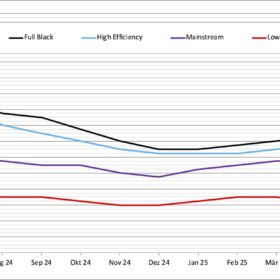
Photovoltaic business currently unsustainable in many segments
PV module prices remain largely flat despite slight increases for high-efficiency products, as sluggish supply has yet to signal a clear trend, says Martin Schachinger, founder of pvXchange.com.

Nuclear has highest investment risk; solar shows lowest, say US researchers
Nuclear power plants exceed construction budgets by an average of 102.5%, costing $1.56 billion more than planned, according to a study by Boston University’s Institute for Global Sustainability.

Bosnia and Herzegovina breaks ground on 125 MW solar plant
Bosnia and Herzegovina has started working on a 125 MW solar plant – its largest to date. China’s Norinco International will build the facility, with completion expected in one year.
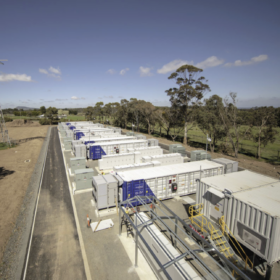
Global battery storage deployments hit nearly 9 GWh in April, says Rho Motion
China and Chile led battery storage deployments in a more evenly distributed scene than in previous months, but a lower overall total was installed at grid-scale.
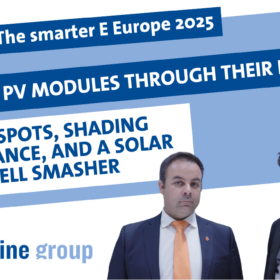
Putting PV modules through their paces
Back contact cells, long seen by many as too complex or costly for mainstream PV manufacturing, are a growing industry trend in 2025. Mark Hutchins stopped by Aiko’s booth, where Claudio Godinho, Europe Service Director at Aiko, treated us to live demonstrations of how the company’s back contact PV modules perform under conditions including partial shading, high temperatures, and mechanical stress.
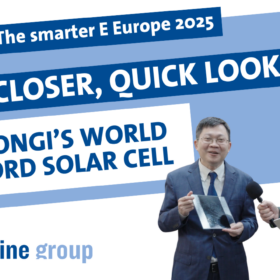
A closer, quick look at Longi’s world record back contact solar cell
pv magazine visited Longi’s booth at Intersolar in Munich and had a quick chat with Charles Yiang, President of Distributed Generation Business Group. He visually showed both sides of the 27.81% hybrid interdigitated back contact (HIBC) crystalline silicon solar cell that a few weeks ago achieved the world record efficiency for single-junction silicon solar cells.
