
Finland to host 90 GWh thermal energy storage system
Vantaa Energy plans to construct a 90 GWh thermal energy storage facility in underground caverns in Vantaa, near Helsinki. It says it will be the world’s largest seasonal energy storage site by all standards upon completion in 2028.

France issues new rules for agrivoltaics
The French government has published long-anticipated rules defining conditions for installing PV panels on agricultural areas, with consideration for the coverage rate and acceptable loss of agricultural yield.
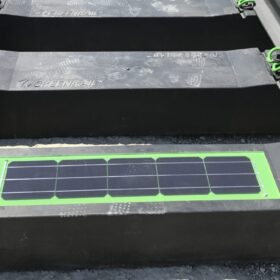
Italian startup testing PV sleepers on railway line
Greenrail Group has started deploying special its PV railroad-tie solution along a railway line in Emilia Romagna, Italy. The company designed the system according to the UNI 10349 standard.

Micro photovoltaic drone achieves 3.5 min autonomy
The photovoltaic micro aerial vehicle has a footprint of 0.15 m x 0.15 m and a weight of only 0.071 kg. According to its creators, it is the smallest solar-rechargeable multi-rotor ever developed to date. It uses a 22.6%-efficient solar module technology from US-based Sunpower and a 0.3 Ah storage system based on lithium polymer batteries.
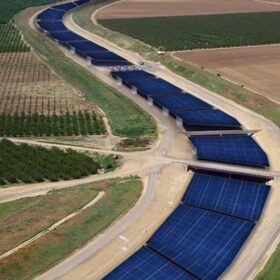
US states to conserve land, water with solar on canals
Three large projects in California, Utah, and Oregon will cover water reclamation facilities with solar panels, offering co-benefits for energy production and water conservation.
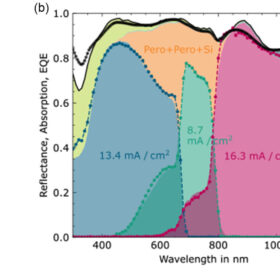
Perovskite-perovskite-silicon triple-junction solar cells have technical potential to reach 44.3% efficiency
A German research team has investigated the optical properties of perovskite/perovskite/silicon triple-junction cells and has found these devices may have a practical efficiency potential of 44.3% assuming idealized electrical parameters. These cells may also potentially achieve a fill factor of 90.1%.

Longi releases wafers for TOPCon, heterojunction, back-contact cell tech
Chinese manufacturer Longi says that its new wafers offer a notable efficiency boost of approximately 0.1% across various cell technologies.

Johnson Controls unveils new residential heat pump series
The new heat pumps use R-454B as a refrigerant and have a size ranging from 2 tons to 5 tons. Their coefficient of performance (COP) ranges between 3.24 and 3.40, according to the manufacturer.
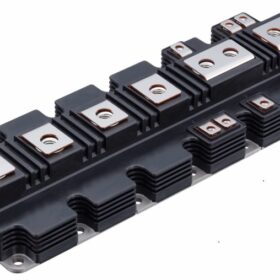
Fuji Electric launches high-power module for large power converters
The Japanese manufacturer said its latest power semiconductor module is based on a compact insulated-gate bipolar transistor (IGBT) and is designed for large capacity industrial power converters voltage of 2,300 V.
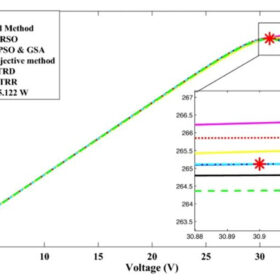
Optimization technique to extract unknown PV system parameters from manufacturers’ datasheets
Developed by an international research team, the proposed methodology can reportedly be used with all kinds of solar panels and under different environment conditions. It relies uniquely on the specifications of the modules’ datasheet, temperature and insolation intensity.
