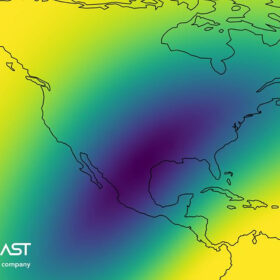
April total eclipse to impact solar generation from Mexico to New England
In a new weekly update for pv magazine, Solcast, a DNV company, reports that, on April 8, a total eclipse will pass from Mexico, across Texas and up the East Coast, with most of the continental US experiencing a significant drop in solar generation.

New research shows potential of hydrogen-source heat pumps
A new research project, thought to be the first to assess hydrogen as an energy source for heat pumps, has found that hydrogen-backed heat pumps could be an eco-friendly option for the building sector and support decarbonization in line with the UK’s net-zero targets.

AEG launches 23.3%-efficient ABC solar panel with 40-year warranty
AEG is currently offering three versions of its new ABC solar panels for rooftop applications, with power outputs of 445 W to 455 W and efficiency ratings ranging from 22.8% to 23.3%. They feature half-cut ABC cells with n-type technology.
AI tech for DC arc detection in PV systems
Scientists from China have developed a novel system that can detect DC arcs in PV installations through a back-propagation neural network. The novel technique reportedly ensures a detection time of less than 200 ms.
Sandia National Laboratories introduce grid-resiliency algorithms
Sandia National Laboratories developed software with tools to isolate downed or damaged lines, automate energy production and consumption regulation, and troubleshoot unintentional loops.
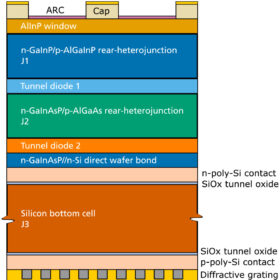
Fraunhofer ISE, AMOLF reveal details of record-breaking 36.1%-efficient triple-junction silicon solar cell
The two research institutes described the triple junction device’s features in a new paper. The cell relies on a top cell based on gallium indium phosphide (GaInP), a middle cell relying on gallium indium arsenide phosphide (GaInAsP), and a silicon bottom cell.
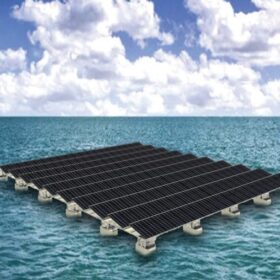
UAE startup unveils floating structure for offshore PV
Dubai-based Floating Man is currently negotiating contracts for the deployment of a novel floating structure for offshore solar. A 900 m2 system built with the floaters could support up to 200 solar panels.
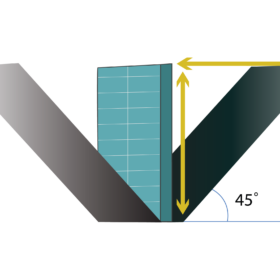
Radiative cooling tech for vertical solar panels
Developed by a US-Saudi research group, the novel technique employs two 45-degree inclined mirrors on the two sides of a PV module. On the back side, a spectral selective reflector enables the thermal radiation to be directed to the sky while preventing the back of a module from heating up by the scattered sunlight.
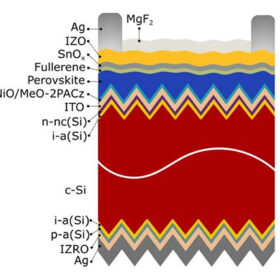
Perovskite-silicon tandem solar cell with sublimed C60 source material achieves 30.9% efficiency
The result was certified by Fraunhofer ISE CalLab. The cell uses a top inverted PV device using an electron transport layer made of thermally evaporated buckminsterfullerene (C60) with minimized parasitic optical absorption.
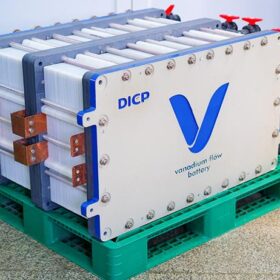
Chinese researchers develop high power density vanadium flow battery stack
Researchers at the Dalian Institute of Chemical Physics (DICP) in China have developed a 70 kW-level vanadium flow battery stack. The newly designed stack comes in 40% below current 30 kW-level stacks in terms of costs, due to its volume power density of 130 kW/m3.
