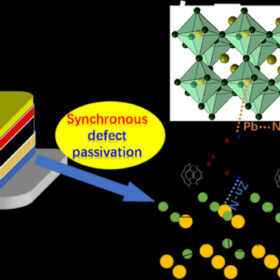
Inorganic perovskite PV cell hits 17.04% via fullerene-derivative interlayer
Researchers have achieved an efficiency boost of 15.44% to 17.04% in all-inorganic perovskite solar cells by incorporating a conductive fullerene-derivative interlayer between the perovskite and electron transport layers. They claim that this enhancement also improves thermal stability.
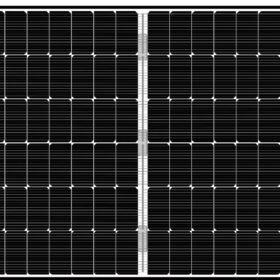
Yingi releases n-type TOPCon solar modules for offshore floating PV
Yingli is offering six versions of its new 144-cell Panda 3.0 PRO solar modules, with power outputs ranging from 555 W to 580 W and efficiencies ranging from 21.48% to 22.45%. The panels are designed for near-shore and offshore floating solar plants.
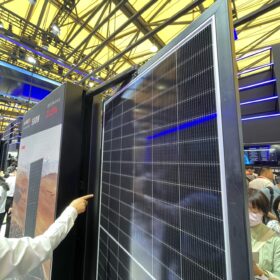
Longi launches 590 W TOPCon solar panel with 22.8% efficiency
The new series comes in seven versions, with power outputs between 560 W and 590 W. The power conversion efficiency ranges between 21.7% and 22.8%
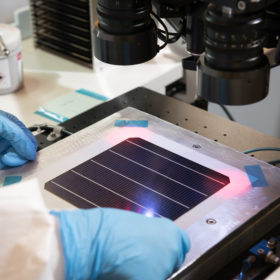
Oxford PV sets 28.6% efficiency record for full-size tandem cell
Oxford PV, a leading perovskite solar pv company with operations in England and Germany, achieved power conversion efficiency of 28.6% for a two-terminal perovskite-silicon tandem cell measuring 258.15 cm² cell: A world record for a device based on a ‘full size’ silicon wafer. The record was certified by Fraunhofer Institute for Solar Energy Systems (Fraunhofer ISE).
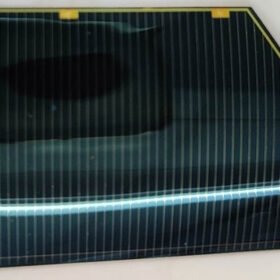
Five-junction III-V solar cell with 35.1% efficiency
Chinese researchers have used metal-organic chemical vapor deposition (MOCVD) to produce a 12 cm2, five-junction solar cell with a minimal number of mismatch dislocations. The cell has an open-circuit voltage of 4.727 V, a short-circuit current density of 860 mA/m2, and a fill factor of 86.38%.
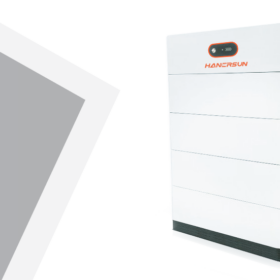
Hanersun unveils high-voltage residential battery
Chinese module manufacturer Hanersun has introduced six versions of its new stackable, high-voltage residential batteries, ranging in nominal capacities from 7.5 kWh to 20 kWh. The batteries, which feature lithium-iron phosphate (LFP) technology, come with a five-year warranty.
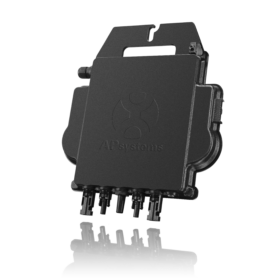
APsystems releases microinverter for balcony PV systems
APsystems has developed an EZ1 microinverter with an efficiency rating of 97.3% and a nominal maximum power point tracker (MPPT) efficiency of 99.5%. It can be connected to two high-power solar modules.

Origami Solar develops light steel frames for solar modules
Origami Solar developed its new steel solar module frames in collaboration with global steel industry partners, in order to facilitate a smooth transition to high-volume, regional production.

Biofuels vs. solar electricity for urban mobility
Solar electricity will have to compete with biofuels in the urban mobility landscape. Biofuels, however, have a very low energy productivity per hectare, as well as high requirements for fertilizers, pesticides, and water.
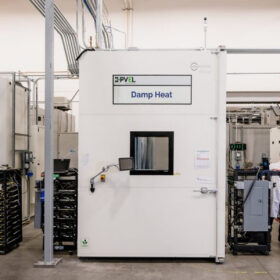
PVEL releases ninth edition of ‘PV Module Reliability Scorecard’
The PV Evolution Labs (PVEL) 2023 Scorecard identifies 250 solar modules from 35 manufacturers as “top performers.”
