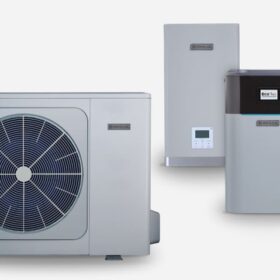
Weil-McLain launches dual-fuel heat pumps for residential, light commercial applications
The US-based heating specialist said its new air-to-water heat pumps use difluoromethane as the refrigerant and have a coefficient of performance of up to 5.37.

New method to predict solar module lifespans under sand erosion
A team of researchers in Algeria has designed a new testbed and a novel acceleration law that accounts for both wind speed and sand density. The new methodology was tested on four PV modules and showed lifespans of up to 47 years in terms of sand impact.
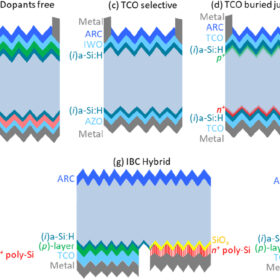
TU Delft research suggests back contact tech may push crystalline silicon PV over 28% threshold
Researchers in the Netherlands have investigated how carrier-selective contacts may help achieve stronger performance in back-contact (BC) crystalline silicon solar cells and have predicted efficiencies may reach up to 28.64%. Their analysis considered work function, energy barriers, and energy alignment across the stack of layers.
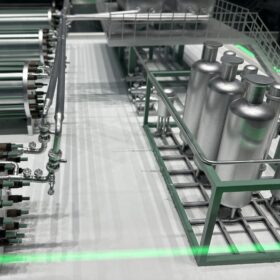
The Hydrogen Stream: Spanish government allocates €1.2 billion for renewable H2 clusters
The Spanish government allocated €1.2 billion ($1.26 billion) for seven green hydrogen clusters concentrated in Aragon and Andalusia. Meanwhile, an EU consortium started its work to develop diagnostic and monitoring tools for water electrolyzers.

Polyshine Solar unveils ultralight, flexible rooftop solar panels
The Chinese manufacturer said its new flexible modules have an efficiency of up to 20.1% and a weight of only 7.5 kg, or 2.92 kg/m2. The new products have purportedly a light transmittance of over 91% and “ultra-high” UV blocking ability.

Lennox debuts residential heat pump for cold climates
The company says that its new SL22KLV heat pump system can supply heat in temperatures as low as -28.9 C. It uses R-454B as the refrigerant and has a size ranging from 2 tons to 5 tons.
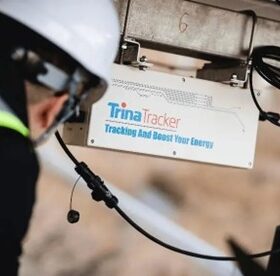
Chinese PV Industry Brief: China General Nuclear concludes 10 GW mounting system tender
The selected bidders are Trina Solar, Antai Ke Clean Energy, Xin Yuan Electric, Guoqiang Xing Sheng Energy Technology, and TBEA, with the winning bid prices ranging from CNY 0.209 ($0.29)/W to CNY 0.221/W.

Austrian startup presents vertical bifacial PV systems for garden fences
Sunbooster GmbH is offering 372 W flexible solar systems including inverters and cabling. The price for the smallest version is €500 ($524).

Solar, battery-equipped home destroyed by explosion in Germany
In the German state of Schleswig-Holstein, an explosion tore away the outer wall of a show home equipped with solar panels and a residential battery. The badly-damaged building, which was vacant at the time of the incident, will likely be demolished.
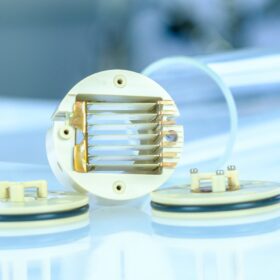
Fraunhofer institutes developing electrocaloric solid-state heat pump without compressors
Six Fraunhofer institutes are developing new electrocaloric heat pumps that use elastocaloric heat pipes instead of compressors to extract heat from the sources. The first pilot systems developed by the research team achieved an electrical efficiency of 99.74%.
