
Nine-year EL testing on 85,000 PV modules shows increasing presence of edge ribbon cracks
A UK research team used electroluminescence imaging to inspect 167 PV installations comprising a total of 5 million solar cells. Defects were categorized into into line cracks, complex cracks, edge-ribbon cracks, and potential-Induced degradation (PID).
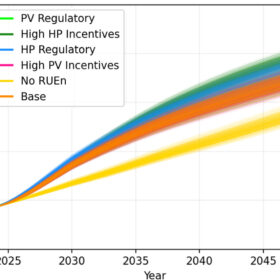
Stuck in a loop: The co-adoption dynamics of PV and heat pumps
Scientists in Switzerland have created a system-dynamics model for the adoption of PV and heat pumps in Swiss residential buildings up to 2050. They have examined several scenarios to see how the incentive for PV affects heat pump adoption and the other way around, and they have concluded that strong regulatory changes are necessary to completely decarbonize the residential sector.

Custom-colored modules increase social acceptance of building-integrated photovoltaics
A study by the University of Freiburg and the Fraunhofer Institute for Solar Energy Systems finds that deploying color-matching solar modules on a building’s roof or facade further increases social acceptance of building-integrated photovoltaics (BIPV).

‘Typhoon-resistant’ offshore PV project nears completion in China
China Three Gorges Corp. has nearly completed a 180 MW offshore solar plant, designed for typhoon resistance, off the coast of China.
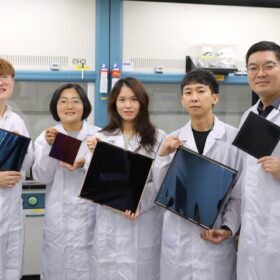
KRICT sets world record with 20.6% efficiency for large-area perovskite cells
The Korea Research Institute of Chemical Technology (KRICT) has set a world record for power conversion efficiency at 20.6% for large-area perovskite solar cells exceeding 200 cm². The result, confirmed by Germany’s Fraunhofer Institute for Solar Energy Systems ISE (Fraunhofer ISE), marks a significant milestone in solar cell technology.
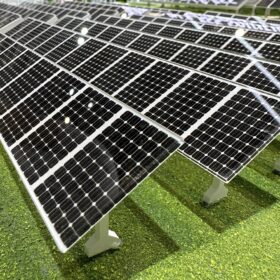
Digital twin for autonomous aerial monitoring of PV power plants
An international research team has created a digital twin that purportedly enables analysis of different scenarios on PV plants’ aerial monitoring. The new tool is claimed to reduce the risk associated with real-world experimentation and help identify the most effective strategies to improve PV system monitoring.
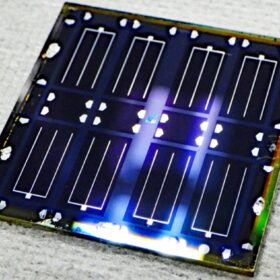
Indium-free chalcopyrite solar cell achieves 12.25% efficiency
Japanese scientists have developed a wide-bandgap chalcopyrite solar cell that can reportedly achieve high open-circuit voltage and fill factor values. The device is intended for use in top cell applications in tandem devices.

UtmoLight unveils 450 W perovskite solar module with 16.1% efficiency
Chinese manufacturer UtmoLight has developed a 450 W perovskite solar module with a 16.1% efficiency rating. It claims that the panel is currently the largest perovskite PV module available.

Testing to start on 100 MWh sand-based thermal battery in Finland
Finnish startup Polar Night Energy is building an industrial-scale thermal energy storage system in southern Finland. The 100-hour, sand-based storage system will use crushed soapstone, a by-product from a fireplace manufacturer, as its storage medium.

Deye launches 2 kWh hybrid ESS for residential, off-grid PV
Chinese manufacturer Deye says its new energy storage system (ESS) features a microinverter, a lithium iron phosphate (LFP) battery module, and a battery management system (BMS).
