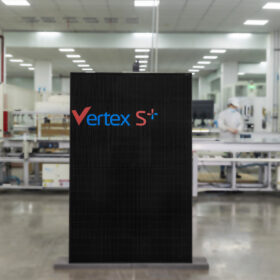
Trina Solar begins mass production of 430-455 W full-black modules
Trina Solar says it has launched mass production of 430 W to 455 W full-black PV modules. The Vertex S+ panels have efficiencies of up to 22.8% and weigh 21 kg, with a 1.6 mm x 1.6 mm dual-glass design.

Recursive least squares algorithms to detect abnormal operation in PV systems
Scientists in Spain have implemented recursive least squares (RLS) algorithms for anomaly detection in PV systems and have found they can provide “more realistic and meaningful assessment” than traditional energy analysis.

Pre-assembled residential solar canopy HelioWing product launches
World4Solar has launched a pre-assembled residential solar canopy, HelioWing, at an event in its warehouse in Miami, Florida.
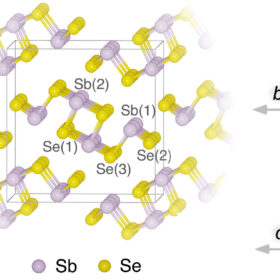
Antimony selenide solar cells may reach efficiencies of up 26%
New research from the United Kingdom sees potential to double efficiency of antimony selenide absorbers, beyond today’s champion cells with 10%, by applying latest growth methods, reducing vacancy concentrations, and materials optimization.

BirdBlocker unveils bird-proofing solutions for rooftop PV at Intersolar
Dutch company offering bird-proofing solution for solar installations expands its range with a trio of launches – with high hopes that its business can take flight on commercial rooftops.
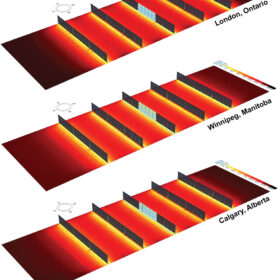
What crops fit with vertical agrivoltaics?
Research at three Canadian locations tried to identify which crops can grow between differently spaced rows of vertical agrivoltaic systems. The scientists concluded that all traditional corps could be grown at the research sites, including arugula, beets, bok choy, celery, coriander, collards, fava beans, kale, lettuce, parsley, parsnips, peas, swiss chard, and thyme.

Hoymiles launches AC-coupled battery for balcony PV systems
The Chinese company says its new product has a storage capacity of 2,240 Wh and an expected lifespan of 6,000 cycles.

Solimpeks presents air-to-water heat pump for residential, commercial applications
The Turkish manufacturer said its Varm BCP heat pump has a heating capacity of 3 kW at 20 C outdoor temperature and a coefficient of performance ranging from 3.62 to 4.48.
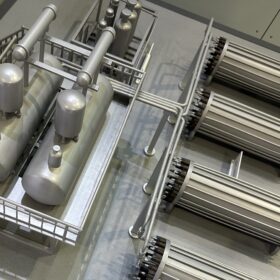
The Hydrogen Stream: Rolls-Royce unveils hydrogen combustion engine for CHP
Rolls-Royce has started developing a hydrogen combustion engine for combined heat and power (CHP) systems in Germany, while Lhyfe has installed a 1 MW electrolyzer for Deutsche Bahn.
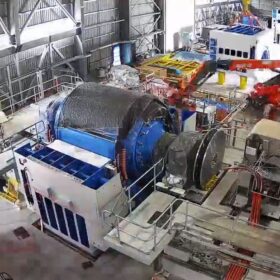
Australian grid operator to boost system strength with synchronous condensers
Transgrid – the owner of the power grid in New South Wales, Australia – aims to roll out up to 14 synchronous condensers and 4.8 GW of batteries with “grid-forming” capability to stabilize the electricity grid as coal-fired power plants retire and more renewables come online.
