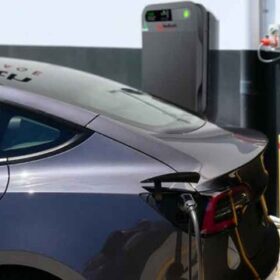
RedEarth unveils V2G EV charger
Australian energy storage manufacturer RedEarth Energy Storage is set to bring its Australian-made vehicle-to-grid electric vehicle charge to market, and has also released two next generation products from its smart energy ecosystem.

Elecnova releases 1 MW/2 MWh ESS for grid-scale use
The Chinese company says its new product is available in a standard container configuration. Its liquid and forced-air cooling systems reportedly maintain a cell temperature difference of just 3 C

Ascent Solar testing CIGS modules for power beaming, marine applications
The US-based developer of copper indium gallium selenide thin-film PV products said its modules will be tested without modifications by companies developing marine PV and power beaming applications.

Frankfurt airport now hosting 17.4 MW vertical PV plant
Next2Sun constructed the photovoltaic system with 37,000 vertically mounted solar modules. It stretches over a length of 2.8 km along the airport’s Runway West.

RatedPower enhances solar plant design platform with 3D simulation capabilities
RatedPower has introduced a 3D simulation feature to improve accuracy in utility-scale solar design, enabling more precise yield modeling that reflects terrain variations and shading, validated against real production data.
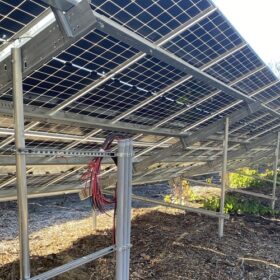
Machine learning-based fault detection technique for bifacial PV
A UAE research team developed a hybrid 1D-CNN and random forest model to detect multiple faults in bifacial PV systems, including dust, shading, aging, and cracks. Using simulated I-V curves and a 180-day synthetic dataset, the model achieved up to 100% accuracy in general state detection and 97.6% in specific fault classification.

Unlimited low-cost energy storage
In its latest monthly for pv magazine, the International Solar Energy Society (ISES) explains how pumped-hydro energy storage combined with PV power generation could provide 24/7 power to data centres

Alsym Energy launches sodium-ion battery line
The Massachusetts-based startup says its new battery is non-flammable, non-toxic, and uses non-FEOC (Foreign Entity of Concern) materials, aiming for a lower levelized cost of storage (LCOS). The technical specs provide some highlights as well.
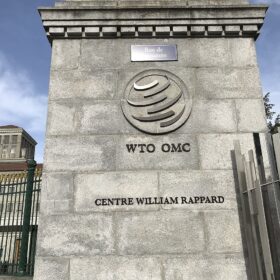
What WTO can still do to regulate global cleantech trade
pv magazine spoke with energy and environmental law expert Anatole Boute about the past and future role of the World Trade Organization (WTO) in regulating trade disputes related to clean energy technologies amid current geopolitical tensions. He noted that despite recent protectionist efforts to revive the solar manufacturing industry, the European Union still strives to remain compliant with WTO rules.

Mercedes unveils car with 20% efficient ultra-thin solar coating
Mercedes-Benz unveiled its first car prototype with a silicon-free, 20%-efficient nanoparticle solar coating that powers the vehicle even when off and uses modules thinner than a human hair.
