Weekend Read: Pushing perovskite PV limits
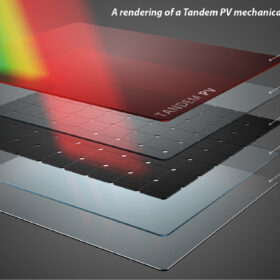
The perovskite solar race is heating up, with a cue of manufacturers forming to test products at the US Department of Energy’s (DoE) PV commercialization facilities, and academics on both sides of The Pond announcing new advances in recent months.

The Hydrogen Stream: Namibia to launch $10 billion hydrogen project
German investors have agreed to back a hydrogen project in Namibia, while Plug Power and Thyssenkrupp Nucera have announced separate hydrogen-related deals in Sweden.
Anti-soiling PV coating delivers 3% boost in energy production
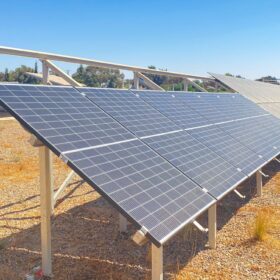
A study conducted in the semi-arid weather conditions of Ben Guerir, Morocco, evaluated the performance of antistatic and hydrophobic coatings for photovoltaic solar panels. After nine months of operation, the PV panels with coatings developed by Portuguese company ChemiTek produced an average of 3% more energy than the uncoated ones.
Eging releases 580 W TOPCon PV module with 22.45% efficiency
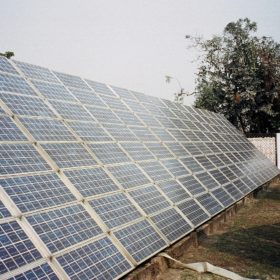
China’s Eging has unveiled a new line of bifacial TOPCon solar panels based on n-type wafers and 182 mm cells. The modules have a temperature coefficient of -0.30% and efficiencies ranging from 21.67% to 22.45%.
Smoke from early fire season impacts irradiance across North America
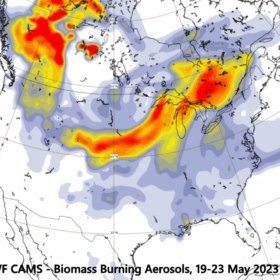
In a new weekly update for pv magazine, Solcast, a DNV company, presents the solar irradiance data it collected for North America since early May. The province of Alberta saw close to 100 wildfires raging from the beginning of the month and solar asset operators throughout the impacted regions can expect reduced efficiency from both the irradiance impacts and increased panel soiling.
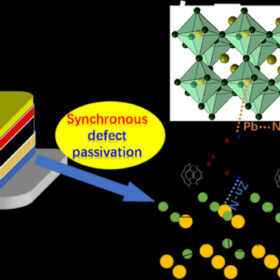
Inorganic perovskite PV cell hits 17.04% via fullerene-derivative interlayer
Researchers have achieved an efficiency boost of 15.44% to 17.04% in all-inorganic perovskite solar cells by incorporating a conductive fullerene-derivative interlayer between the perovskite and electron transport layers. They claim that this enhancement also improves thermal stability.
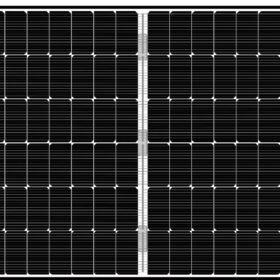
Yingi releases n-type TOPCon solar modules for offshore floating PV
Yingli is offering six versions of its new 144-cell Panda 3.0 PRO solar modules, with power outputs ranging from 555 W to 580 W and efficiencies ranging from 21.48% to 22.45%. The panels are designed for near-shore and offshore floating solar plants.
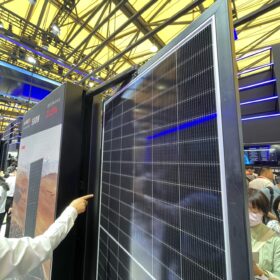
Longi launches 590 W TOPCon solar panel with 22.8% efficiency
The new series comes in seven versions, with power outputs between 560 W and 590 W. The power conversion efficiency ranges between 21.7% and 22.8%
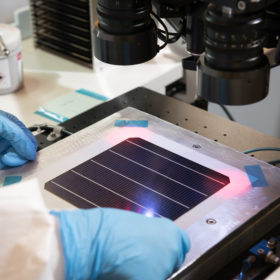
Oxford PV sets 28.6% efficiency record for full-size tandem cell
Oxford PV, a leading perovskite solar pv company with operations in England and Germany, achieved power conversion efficiency of 28.6% for a two-terminal perovskite-silicon tandem cell measuring 258.15 cm² cell: A world record for a device based on a ‘full size’ silicon wafer. The record was certified by Fraunhofer Institute for Solar Energy Systems (Fraunhofer ISE).
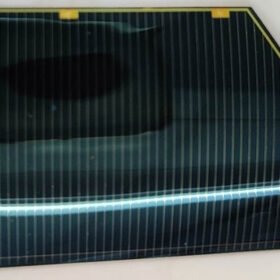
Five-junction III-V solar cell with 35.1% efficiency
Chinese researchers have used metal-organic chemical vapor deposition (MOCVD) to produce a 12 cm2, five-junction solar cell with a minimal number of mismatch dislocations. The cell has an open-circuit voltage of 4.727 V, a short-circuit current density of 860 mA/m2, and a fill factor of 86.38%.
