
Austria deploys 1 GW of PV in January-September period
Austria added 1,036 MW of new solar capacity between January and September 2025, down from 1,419 MW over the same period in 2024, as political uncertainty, delayed legislation, and weakening residential demand strain the solar sector.
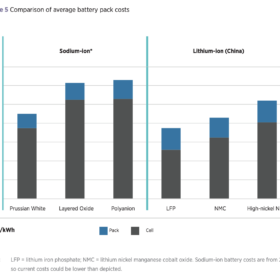
Sodium-ion battery cell cost could drop to $40/kWh, says IRENA
A report from the International Renewable Energy Agency (IRENA) notes that while it is still uncertain whether sodium-ion batteries will become a disruptive alternative to lithium-ion technology, they could offer significant cost-saving opportunities in applications such as electric vehicles and large-scale energy storage.

Japan pilots low-weight solar panels, perovskite windows for buildings
Mitsui Home and Tokyo Gas have revealed plans to deploy Japan’s first combined on-site and virtual solar power purchase agreement (PPA), cutting factory emissions and maximizing rooftop energy use.

N-type wafer prices extend four-week slide amid weak demand, rising inventory concerns
In a new weekly update for pv magazine, OPIS, a Dow Jones company, provides a quick look at the main price trends in the global PV industry.

Australia’s Tindo Solar plans expansion as ARENA funding reshapes outlook
Australian module maker Tindo Solar says Australian Renewable Energy Agency (ARENA) funding of AUD 34.5 million ($22.5 million) will support expansion at its South Australia facility as it navigates soft demand, technology shifts, and manufacturing constraints.
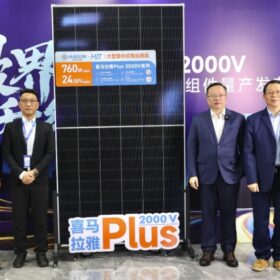
Huasun unveils 770 W, 2,000 V heterojunction solar module
The Chinese manufacturer said the higher-voltage design of the new module reduces cable, combiner, pile-foundation, and land-use requirements, delivering balance-of-system savings of up to CNY 0.15 ($0.012)/W in western China. The module offers a power output of 730 W to 770 W and a conversion efficiency of up to 24.8%.
India forecast to add 41.5 GW of new solar capacity in fiscal 2026
JMK Research expects India to install 41.5 GW of solar capacity in fiscal 2026, including 32 GW from utility-scale projects, 8 GW from rooftop systems and 1.5 GW from off-grid installations.
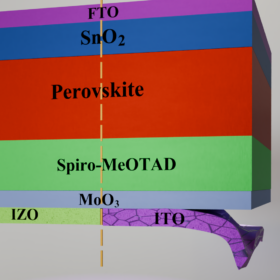
Highly transparent perovskite solar cell achieves 18.22% efficiency
A research team in India has investigated the use of highly conductive transparent electrodes based on amorphous indium zinc made with a room temperature process in perovskite solar cells. The devices could be used in tandem and building-integrated PV applications.

Switzerland introduces winter electricity bonus for solar installations
Switzerland is implementing a new winter electricity bonus for solar installations larger than 100 kW that generate over 500 kWh/kW of electricity in the winter half-year from October 1 to March 31. The country’s Federal Council has also raised the target for electricity generated by photovoltaics to 18.7 TWh by 2030.
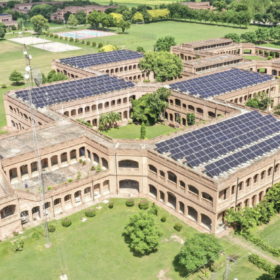
Pakistan needs to declare a ‘battery emergency’
Solar association chair argues urgent battery energy storage deployment is key to supporting continued PV boom in Pakistan. Residential solar CEO predicts surge in behind-the-meter storage demand if and when Pakistan’s generous net metering policy is wound down.
