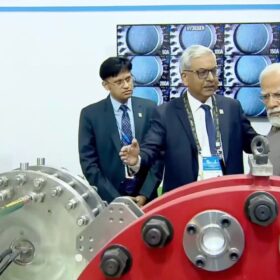
Indian oil producer unveils alkaline electrolyzer
Bharat Petroleum Corp. Ltd. (BPCL) has developed an alkaline electrolyzer in collaboration with India’s Bhabha Atomic Research Centre (BARC).
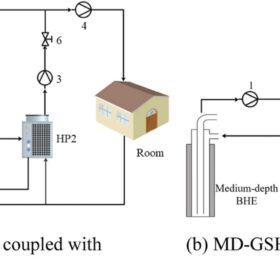
Coupling ground-source heat pumps with heat storage, borehole heat exchangers
Scientists from China have developed a novel optimization method for medium-depth ground source heat pumps, using an improved chaos particle swarm optimization. They coupled it with either a heat storage tank or a shallow borehole heat exchanger and found that both system typologies increase the heat pump’s coefficient of performance.
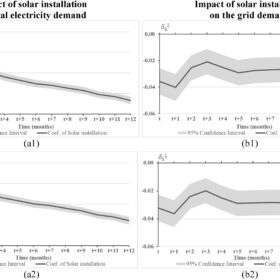
The solar rebound effect in residential PV
The rebound effect consists of a reduction in expected gains from a more resource-efficient technology as a result of behavioral or systemic change. An international research team has investigated this phenomenon in the residential PV segment in Vietnam and has found that it could happen in any country where the policy supporting solar power is not fully and scientifically explained.

India’s SJVN launches 1.5 GW wind-solar hybrid tender
Developers have until March 15 to express interest in setting up 1.5 GW of wind-solar hybrid power projects on a build-own-operate basis throughout India. The projects must connect to the interstate transmission system (ISTS).
The Hydrogen Stream: Zaha Hadid designs marina refueling stations
Zaha Hadid Architects has unveiled the world’s first green hydrogen refueling network for recreational boats at marinas in Italy, while a German-Czech consortium has announced the development of a drivable hydrogen motorcycle.
Chinese PV Industry Brief: GCL SI, Trina, Risen predict strong earnings for 2023
GCL System Integration (GCL SI), Trina Solar, and Risen Energy have all announced significant increases in revenue and net profit for 2023.
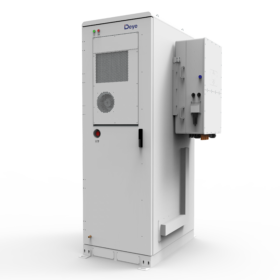
Deye releases new 50 kW/61.4 kWh battery
Chinese inverter manufacturer Deye has developed a new all-in-one energy storage system (ESS) with 50 kW of output and 61.4 kWh of storage capacity. It features LiFePO4 batteries with a maximum temperature of less than 40 C.
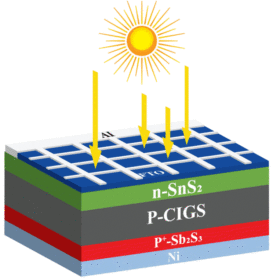
New CIGS solar cell design with antimony trisulfide promises 31.15% efficiency
The novel solar cell uses antimony trisulfide (Sb2S3) as the back surface field (BSF) layer. According to its creators, this layer can be included in conventional CIGS solar cells to improve their efficiency and reduce the absorber material’s cost.

India focuses on residential rooftop PV, EV infrastructure in new budget
Indian Finance Minister Nirmala Sitharaman has submitted an interim national budget for fiscal 2024-25 to parliament, with a focus on residential rooftop solar, funding for offshore wind, and support for EV manufacturing and charging infrastructure.

Chinese PV Industry Brief: Shenzhen Hiking PV to set up GW-level factory
Shenzhen Hiking PV has unveiled plans to set up a joint venture with a state-run company to build gigawatt-level perovskite/polysilicon tandem cell and panel production capacity in Guangdong province, while Hoshine has announced progress at its PV integration park in Xinjiang.
