
Longi says appeal hearing for patent litigation with Hanwha Q-Cells is planned for April
In the first instance, the Düsseldorf Regional Court in Germany ruled in favor of Hanwha Q-Cells, but Longi Solar has appealed the judgment. There is also still a struggle for the validity of the patent between the photovoltaic companies at the European Patent Office. In addition to Longi Solar, REC is also reporting another partial success in the legal dispute with the South Korean photovoltaic manufacturer.
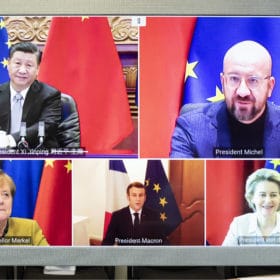
EU-China Comprehensive Agreement on Investment opens manufacturing options, dodges forced-labor issues
The European Commission has finalized its long-anticipated investment agreement with China. While some renewable energy businesses might benefit from improved investment security, IP protection and access to legal remedies in China, the Commission did not address the issue of Uyghur forced labor in China. As a majority block in the European Parliament had previously demanded from the Commisison to develop a firm policy to end forced labor in China, there is reason for doubt that the agreement as it stands will be adopted by the EU Parliament.
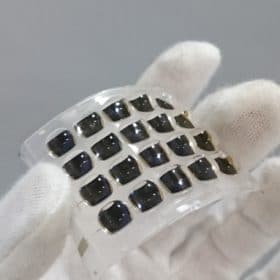
Stretchable CPV module with 15.4% efficiency
Japanese scientists have fabricated a prototype CPV panel that could be applied on spherical surfaces with a curvature radius of 100 mm, and under outdoor one-sun irradiation. The module is based on a silicone concentrator lens, a thermoplastic polyurethane sheet, and a rigid III–V triple-junction solar cell.
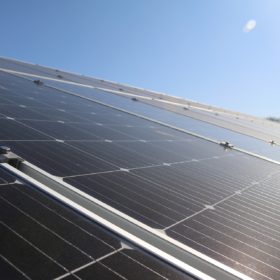
India added 5.2 GW of solar in April-November period
India’s PV capacity additions fell 38% year on year in the first eight months of fiscal 2020-21 (to the end of November), as pandemic-driven disruptions constrained new project development.
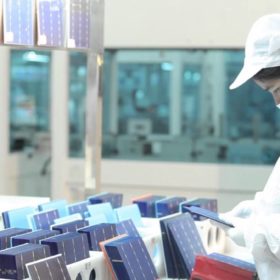
Chinese PV Industry Brief: Jinko begins work on 20 GW cell factory
The solar cell manufacturing facility, located in China’s Yunnan Province, is expected to raise Jinko’s cell capacity to 30 GW by the end of 2021.
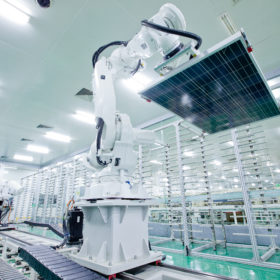
JinkoSolar announces 23.01% efficiency for n-type monocrystalline panel
The PV module relies on Jinko’s TOPCon mono cell technology, for which a record efficiency of 24.9% was announced last week. TÜV Rheinland has confirmed the result.

South Korea may tender 4 GW of solar PV this year
The Korea Energy Agency (KEA) will likely launch two 2 GW tenders in April and October. These will include the procurement of large-scale solar PV parks for the first time.
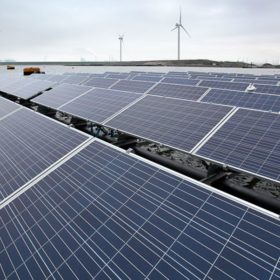
System design key to enhancing cooling effect of water in floating PV
Researchers in the Netherlands and Singapore have measured irradiance-weighted average temperatures of floating PV systems in both countries and have compared the results with reference rooftop and ground-mounted PV systems. They have discovered that floating PV systems with open structures, which allow wind to pass beneath the modules, can provide a higher heat loss coefficient.

Australian iron ore producer, South Korean steelmaker agree to green hydrogen future
Fortescue Metals Group Chairman Andrew ‘Twiggy’ Forrest returned to Western Australia last week after a four-month worldwide search for green energy projects and resources. One of the deals secured on the trip was a circular green hydrogen partnership with South Korean steelmaker Posco.
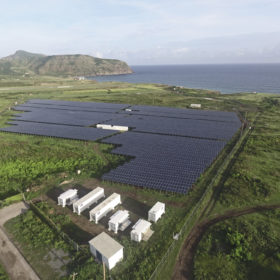
New method to build microgrids based on solar, hydrogen
The use of polymer electrolyte membrane fuel cells as backup power generation in solar microgrids could drive down costs and improve efficiency, according to an international group of researchers. They have proposed a new energy management system that could be ideal for hybrid solar-hydrogen microgrids in remote locations.
