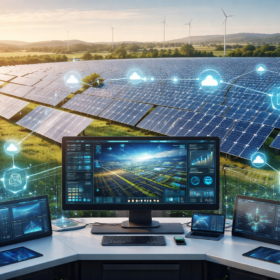
German startup offers team of 22 specialized AI workers for PV plant O&M operations
Invertix has launched 22 specialized AI “workers” to automate O&M tasks for renewable energy assets, targeting inefficiencies in data handling, alarm management, and reporting. The startup says its system enables PV plant operators to scale portfolios more efficiently by reducing manual workloads, while keeping humans in the loop for critical decisions.
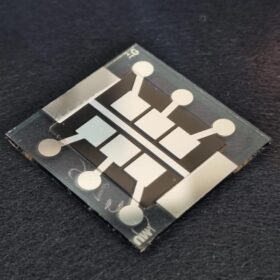
Scientists build high temperature-resistant perovskite solar cell with 26% efficiency
LMU researchers have developed a dual molecular reinforcement strategy for perovskite solar cells that strengthens grain boundaries, improving both durability and performance.
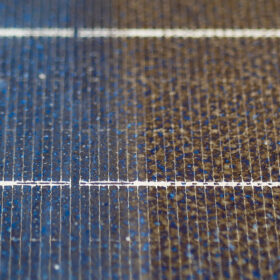
Fraunhofer CSP warns some cleaning agents may reduce PV module performance by up to 5.6%
Researchers at the German institute found that some widely used PV cleaning agents can damage anti reflective glass coatings, significantly reducing solar module efficiency. Their tests showed that while some cleaners are safe, others cause visible and permanent coating degradation, highlighting the need for careful selection of cleaning products to avoid long term performance loss.
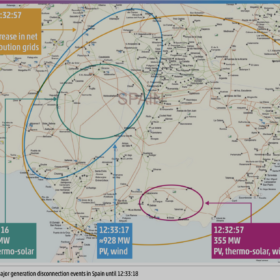
Entso-E report finds systemic failures behind 2025 Iberian blackout
The European Network of Transmission System Operators for Electricity (Entso-E) has published its final root cause report on the April 28, 2025, blackout in Spain and Portugal, finding failures across grid operations, generation, and regulations, and issuing 22 recommendations to strengthen European grid resilience.
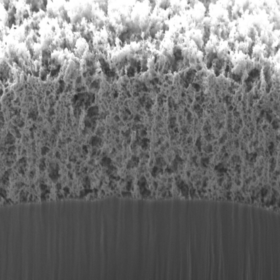
The Hydrogen Stream: Ionautics advances catalyst toward production
Sweden’s Ionautics has advanced its platinum-based hydrogen catalyst toward full-scale industrial production, while thyssenkrupp nucera has signed contracts for 300 MW of alkaline electrolysis capacity in Spain and 260 MW in India.
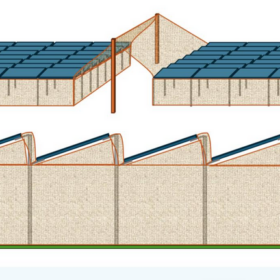
The case for ground-level agrivoltaics
German engineering firm BEC Energie Consult has developed a substructure for low-mounted agrivoltaics designed to provide cost-efficient installation while supporting crop growth and livestock management, with the potential to enhance economic viability.

‘The barriers I encountered were never dramatic, they were cumulative’
This week Women in Solar+ Europe gives voice to Delfina Muñoz, Research Director & Strategic Project Manager at France’s CEA. She says diversity is a catalyst for faster, fairer clean energy innovation. Inclusion, mentorship, and authentic leadership don’t just support people, they build stronger, more resilient teams that power the energy transition forward.
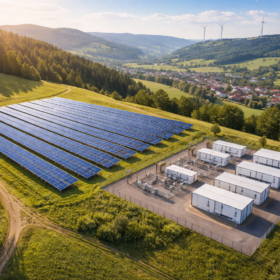
Why technical due diligence is becoming the backbone of Europe’s solar-storage boom
Europe’s hybrid solar-plus-storage projects are growing rapidly, but increasing complexity means treating technical due diligence as a formality is now a serious risk. Rigorous, lifecycle-based technical due diligence (TDD) – covering financial, supply chain, digital, and ESG factors – is essential to ensure project reliability, investor confidence, and a resilient clean-energy transition.
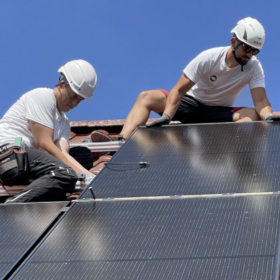
Iran conflict stirs solar demand debate in Germany
Germany’s solar sector is reporting a surge in inquiries following the military escalation between Israel, the United States, and Iran, with E.ON citing a doubling of demand for solar installations. Other industry participants are more cautious, attributing much of the increase to seasonal patterns rather than geopolitical anxiety.
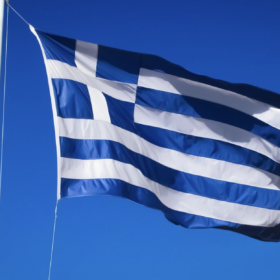
Greece receives 12.2 GW of merchant battery applications for 4.7 GW program
Investors have submitted applications for 12.15 GW of utility-scale, standalone merchant battery storage projects in Greece, far exceeding the 4.7 GW the country plans to approve. But with wrestling over financing and key policy details still unresolved, the path to construction remains unclear.
