
New approach to measure perovskite-silicon tandem PV module performance via LED-based solar simulators
The Fraunhofer ISE has defined new technical procedures to test the performance of large-area perovskite-silicon tandem PV modules by using the spectral variability of the LED solar simulator. The proposed approach reportedly reduces device handling, time, and consequently financial effort.

Photovoltaics for mango drying
Scientists have created a solar cabinet dryer for mango slices, with PV-powered forced convection. Placing mango slices of different thicknesses inside, they have measured the operation of their device against two reference methods and have found that thermal efficiency reached 30%.
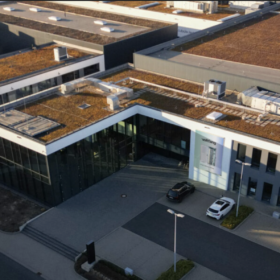
Voltfang opens second-life battery plant in Germany, billed as Europe’s largest
Voltfang has opened what it claims is Europe’s largest second-life battery storage plant in western Germany, with 250 MWh of annual capacity expected in 2026 and a target of 1 GWh before 2031.

Serbia reaches 281 MW of solar capacity
Serbia’s solar market topped 5,000 prosumers in the first half of 2025, though no plants above 10 MW are online. The country has a gigawatt-scale pipeline and procured 124.8 MW in its February renewables auction.

Uncovering UV degradation risks in solar panels
An interview with Fraunhofer ISE on new discoveries of ultraviolet degradation risks.
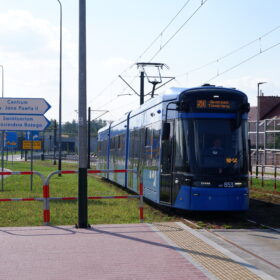
Feasibility assessment for deploying PV panels on tram tracks
New research from Poland has suggested installing 891 PV panels along the entire tram platform and inter-track spaces of four major transportation hubs. The analysis showed that the PV system could power all of the city’s tram stops, the passenger information system, and meet 10% of demand from service depots.

AGC Automotive’s solar roof for passenger cars is ready for mass production
The Belgium-based company announced that its panorama-style solar roof for passenger cars is ready for mass production. The glass-glass design features high-efficiency back contact solar cells and a uniform full black appearance.
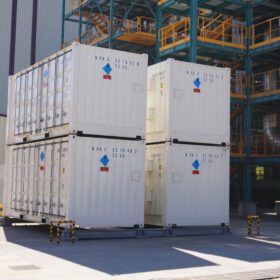
Spain’s CIUDEN tests 5.8 MWh sodium‑sulfur battery with solar and hydrogen
Spanish company CYMI has completed operational testing of a 5.8 MWh sodium‑sulfur (NaS) battery at the City of Energy Foundation’s (CIUDEN) Integra2H2 project, integrated with a 2.1 MW solar plant and two electrolyzers to produce green hydrogen.

Portugal surpasses 6.1 GW of solar capacity
Portugal’s solar capacity reached 6.17 GW in May, according to the country’s renewable energy association. While distributed generation is steadily expanding, a quicker rate of deployment across all market segments will be needed to meet 2030 targets.
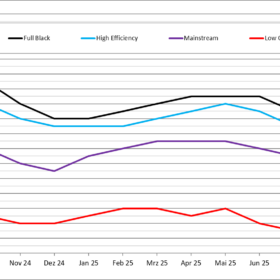
Don’t put off until tomorrow …
… what you can do today. PV and installation professionals should act now as module prices drop to new lows despite efficiency revisions.
