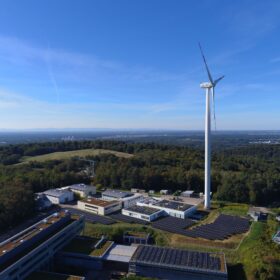
BayWa, Ampt add solar to wind-flow battery project without own inverters
BayWa re and Ampt, in collaboration with the Fraunhofer Institute for Chemical Technology (ICT), have developed an innovative and technically challenging hybrid system featuring 690 kWp of rooftop and ground-mounted PV, a 2 MW wind turbine, and a 10 MWh flow-battery energy storage system.
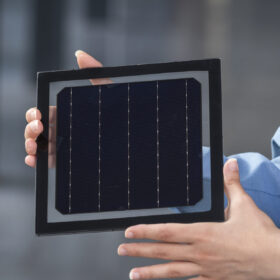
Fraunhofer ISE develops vacuum deposition process for perovksite-silicon tandem solar cells
The German research institute is investigating the use of commercially available vacuum-based evaporation equipment to manufacture perovskite thin films and contacts layers in the fabrication of perovskite-silicon tandem cells.
The Hydrogen Stream: Luxury regions invest in marine hydrogen services
SBM Offshore has installed a floating facility in Monaco to produce green hydrogen from renewables, while Axpo and its partners have revealed plans to use hydrogen to power a passenger vessel in Switzerland.
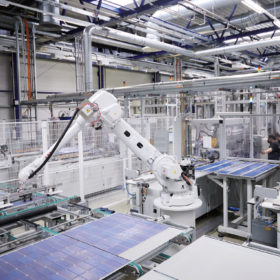
Meyer Burger prepares to shut down plant in Germany
Swiss solar panel maker Meyer Burger will seek shareholder approval for a rights issue of as much as CHF 250 million ($284 million) to finance the completion of its US manufacturing facilities in Colorado and Arizona.
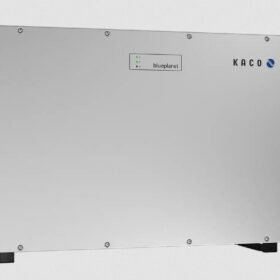
Kaco presents new silicon carbide inverters for C&I solar
Kaco New Energy’s new silicon carbide inverters feature an efficiency rating of 99.1% and a European efficiency of 98.7%.
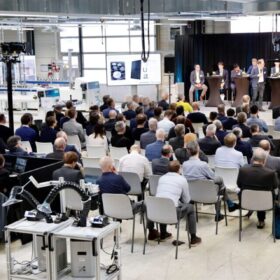
Fraunhofer ISE opens module lab in old Solar Fabrik factory
The Fraunhofer Institute for Solar Energy Systems (Fraunhofer ISE) has opened a PV module production lab for new product ideas in a former Solar Fabrik factory in Germany. It is equipped with systems for cell interconnection, laminators, and a range of materials and solar cell technologies.
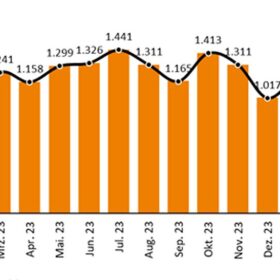
Germany’s new PV additions hit 1.25 GW in January
Germany installed 1.25 GW of solar in January, bringing the nation’s cumulative PV capacity to 82.19 GW by the end of the month, with more than 3.7 million projects in total.
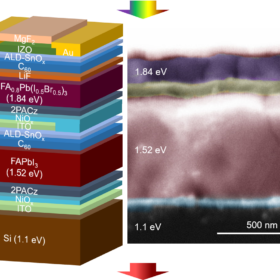
Triple-junction perovskite–perovskite–silicon solar cell achieves record-breaking efficiency of 24.4%
Developed by scientists in Germany, the triple-junction cell is based on a perovskite top cell with an energy bandgap of 1.84 eV, a perovskite middle cell with bandgap of 1.52 eV, and a silicon bottom cell with a bandgap of 1.1 eV. The device achieved an open-circuit voltage of 2.84 V, a short-circuit current of 11.6 mA cm–2, and a fill factor of 74%.
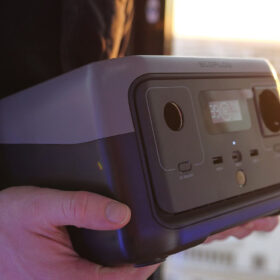
Weekend Read: PV goes portable
Portable solar generators are making their way from the fringes of solar and energy storage to become a mainstream consumer item. The rise has been charged by a range of factors that have created massive brands. Where did the sector emerge from, who was buying before, who is buying now, and what’s next? Tristan Rayner reports.
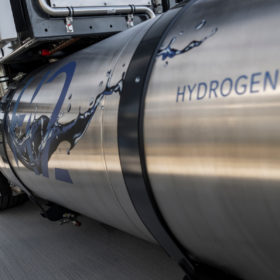
The Hydrogen Stream: Wood Mackenzie calls for focus on life-cycle emissions
Wood Mackenzie has urged policymakers and companies to focus on the full life-cycle emissions of hydrogen, while a European Commission has revealed that a European business mission will visit Mauritania in March to explore hydrogen investment opportunities.
