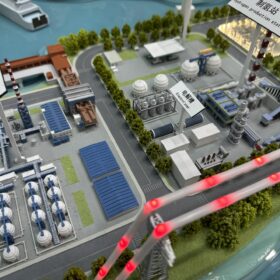
Solar hydrogen could be produced at 4.23$/kg in Saudi Arabia
New research from Saudi Arabia shows that PV, concentrated solar power (CSP), or hybrid PV-CSP systems could significantly reduce the levelized cost of hydrogen. CSP offers higher capacity factors, but PV-driven electrolysis provides the lowest projected cost for hydrogen production.
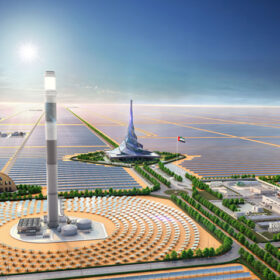
DEWA’s Mohammed bin Rashid solar park capacity hits 3.8 GW
Dubai Electricity and Water Authority (DEWA) says it has added 800 MW of solar to its flagship Mohammed bin Rashid Al Maktoum Solar Park this year alone. By the end of the decade, the site’s cumulative capacity is set to reach 7.26 GW.
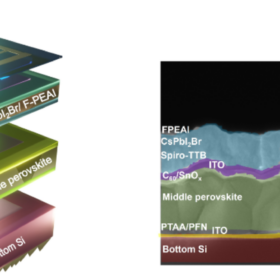
Fraunhofer ISE tests cesium lead perovskite in perovskite-perovskite-silicon triple junction solar cell
Fabricated via thermal evaporation, the champion perovskite-perovskite-silicon triple-junction solar cell reached an efficiency of around 22% after 110 hours of fixed-voltage operation under ambient conditions without encapsulation.

Novel MPPT technique uses fuzzy logic control with new inputs
Academics have developed a maximum power point tracking (MPPT) algorithm for PV systems that combines incremental conductance with fuzzy logic control. The inputs used are the sum of conductance and incremental conductance and its rate of change. It had an average efficiency of 97.7%.
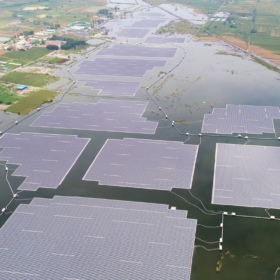
Water-based photovoltaics reach global capacity of 21.18 GW
An international research team has developed an index-based remote sensing method to see trends in the global development of water-based PV. It has found that China currently accounts for 80% of the global total deployed capacity.

Cyprus curtails more than half of renewables, including residential solar
Cyprus curtailed more than half of its potential renewable power in early 2025, including record residential solar cuts, as grid limits and a lack of storage strain its energy transition. Without swift investment in flexibility, analysts warn the country risks eroding public trust and delaying decarbonization.
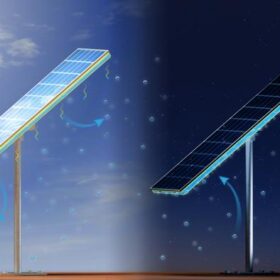
New cooling gel could raise PV module efficiency by 12%
Researchers in Saudi Arabia have developed a hydrogel composite that absorbs moisture in solar modules overnight and facilitates evaporative cooling throughout daylight hours. The system has undergone lab tests and outdoor experiments on two continents.

Testing 54 different combinations of solar-assisted heat pumps
Researchers in Germany have modeled dozens of indirect-expansion solar-assisted heat pump systems using photovoltaic-thermal panels for single-family homes in Munich, Berlin, and Hamburg. Simulations accounted for local weather, electricity use, and thermal demand.
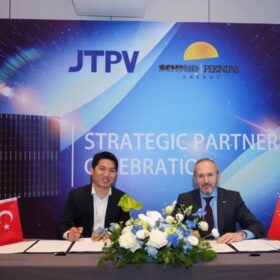
Drinda, Schmid Pekintas to build 5 GW solar cell plant in Turkey
Chinese solar cell maker Drinda and Turkey’s Schmid Pekintas Energy have revealed plans to jointly develop a 5 GW n-type solar cell facility to bypass EU trade barriers.

Perovskite-silicon tandem solar cell built with hybrid blade coating achieves 27.8% efficiency
The King Abdullah University of Science and Technology and the Fraunhofer Institute for Solar Energy Systems report producing perovskite-silicon tandem solar cells with open-circuit voltages exceeding 1.9 V as the result of a two-step hybrid evaporated/blade-coated process for perovskite films.
