
Testing photovoltaic modules in Antarctica’s summer
The Turkish Antarctic Expedition placed four different PV module types – monocrystalline, polycrystalline, flexible and transparent – outside of their research camp for three months to compare performance, finding that monocrystalline was the clear winner.
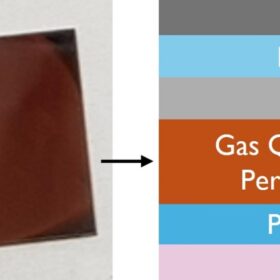
Gas quenching with helium, argon for more stable perovskite solar cells
Kuwait University researchers investigated the relationship between the molecular weight of the quenching gas and the morphology of perovskite films used in solar cells, finding that argon and helium extended device lifetimes compared to using the more conventional nitrogen.
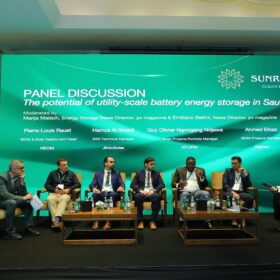
Key takeaways from Sunrise Arabia 2025
A recent joint event by Solarabic and pv magazine in Riyadh highlighted Saudi Arabia’s rapid push for clean energy and localization, with new factories and large storage projects taking shape.
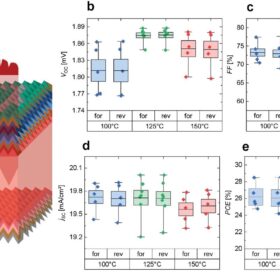
Perovskite-silicon tandem solar cell based on hole selective monolayers achieves 29.8% efficiency
Researchers from Fraunhofer ISE and KAUST built a perovskite-silicon tandem solar cell that reportedly offers improved reproducibility. The device relies on self-assembled monolayers that result in low parasitic absorption and rapid charge extraction.
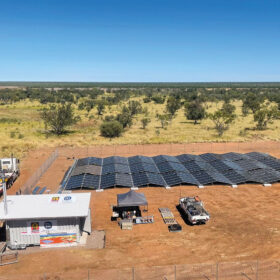
New algorithm for fault detection in renewables microgrids
An Iraqi-Canadian research team has created a new algorithm that can detect direction change in the line current of renewables-based microgrids. The novel approach can be applied to both grid-forming and grid-following infrastructures.
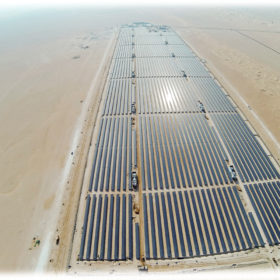
Dubai issues tender for 7th phase of giant solar park
The Dubai Electricity and Water Authority (DEWA) has launched a tender for the seventh phase of the Mohammed bin Rashid Al Maktoum Solar Park, which could add up to 2 GW of PV capacity and 1 GW of battery storage.
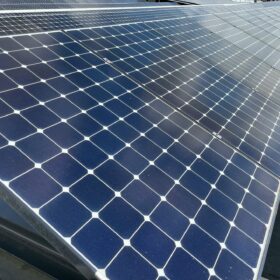
Israel targeting 100,000 new solar rooftops by 2030
Israel’s Ministry of Energy and Infrastructure says its 100,000 Solar Roofs Program aims to add 1.6 GW of new solar capacity by 2030.
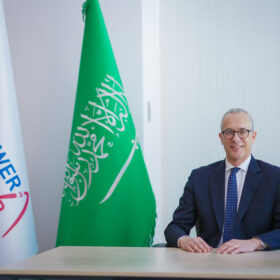
ACWA Power building hydrogen bridge between Europe and Middle East, North Africa
In an exclusive interview with pv magazine, ACWA Power CEO Marco Arcelli said the Saudi energy giant is currently exploring opportunities to build a hydrogen corridor between Europe and the Middle East and North Africa. He spoke about the company’s current 2 GW hydrogen project in Neom and presented the company’s plans for renewable energy and desalination.

Israel awards 1.5 GW energy storage in tender, pricing from $49.41 to $74.20 per kWh
Israel’s storage tender sets prices between $0.0056 and $0.0085 per kW, with kWh figures therefore at $49.41 to $74.20 per kWh.

TrinaTracker establishes 3 GW factory in Saudi Arabia
The facility will manufacture TrinaTracker’s Vanguard series of solar trackers and smart control systems. Commercial operation is set to begin during the first quarter of this year.
