Israel plans 2,000 m2 PV project in occupied Palestinian territories
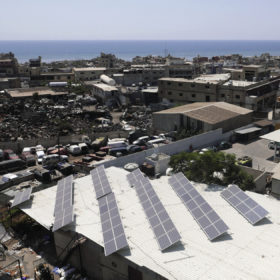
Israel plans to bild a 2,000-square-meter solar PV project in the occupied Palestinian territories and has directed civilian authorities in the West Bank to identify suitable land and launch a tender within a year. The project may also include energy storage options.
Scientists use series active filter to improve power quality of grid-tied PV
Scientists in the Middle East have developed a series active filter to improve power quality in grid-tied PV systems, consisting of an inductor, two capacitors, and four transistor-diode pairs. The filter reduces total harmonic distortion in voltage and current waves at the inverter output.

Jordan’s new electricity law encourages investment in energy storage
The new law aims to improve the efficiency and reliability of Jordan’s electricity infrastructure and introduces the concept of energy storage in the country’s legislation for the first time.

Bahrain launches tender for 44 MW solar plant
The solar project is planned to be located at the University of Bahrain’s campus.

SolarEdge posts $1.21 billion net loss in Q3
SolarEdge reported $260.9 million in revenue for the third quarter of 2024, down from $725.3 million in the same quarter last year. The Israeli manufacturer also posted an operating loss of more than $1 billion, with 850 MW of inverters and 189 MWh of batteries shipped for PV applications.

Turkey launches tender for 800 MW of solar
Turkey’s Ministry of Energy and Natural Resources has launched a tender for 800 MW of solar across six proposed projects. The deadline for applications is Jan. 27, 2025.
Perovskite-silicon tandem solar cell based on copper(I) thiocyanate achieves 31.46% efficiency
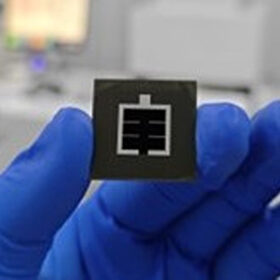
A Saudi-Chinese research team has fabricated a perovskite-silicon tandem solar cell without a hole transport layer (HTL) in the perovskite top cell. This innovative strategy, based on the co-deposition of copper(I) thiocyanate and perovskite in the top cell absorber, was intended at solving typical issues of HTLs in tandem devices.
Saudi Arabia launches tender for 8 GWh of battery storage in world’s largest deal
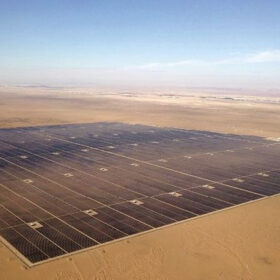
World’s largest storage procurement process is underway in Saudi Arabia for 2 GW/ 8 GWh of storage.

3D-printed anti-reflective cover based on aluminium oxide increases PV cell efficiency by 25%
An international team of scientists have combined cyclic-olefin copolymers with a powder of aluminum oxide to create a filament that can be used by a 3D printer to create anti-reflective covers for PV modules. The proposed innovation can reportedly improve PV cell efficiency by over 25%.
The Hydrogen Stream: UK to fund 11 green hydrogen projects
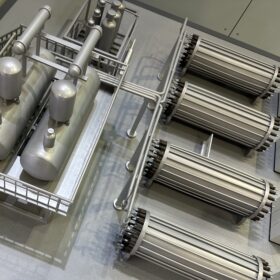
The UK government has confirmed new hydrogen plans, while RWE says it has secured construction and environmental permits to build a 100 MW electrolyzer in the Netherlands.
