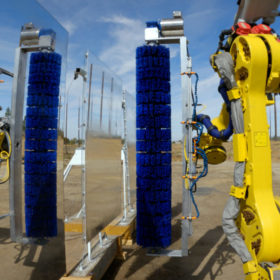
New tank design, autonomous robot for concentrated solar power plants
Two different technological developments were announced this week for concentrated solar power technology. In Australia, a consortium led by Vast Solar filed a patent for a new tank design for thermal energy storage systems. And in the United States, Heliogen announced the rollout of robots to install and clean projects.
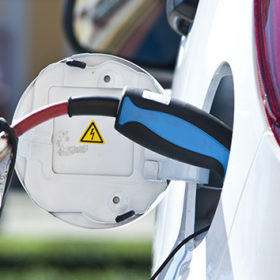
Analyst predicts 2030 bidding war for dead EV batteries
A lack of end-of-life batteries this decade is likely to play into the hands of Chinese recyclers located near most of the world’s production facilities, according to analyst WoodMac, but might at least help rebalance the current situation in which new products are cheaper than recycled ones.
Google lends a hand in the search for new solar cell designs with open-source tool
Scientists in the United States developed a computer simulator that can calculate the conversion efficiency of different solar cell materials and configurations – helping to guide research and optimization of new cell designs. The simulator is available to researchers as an open-source tool to save time and spot the best opportunities for optimization of any given approach.
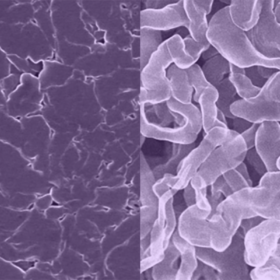
Sodium battery research tackles formation of dendrites
Sodium batteries, an increasingly competitive area of research, have emerged as a low-cost, lithium-free energy storage alternative based on abundant, more environmentally friendly materials. A pair of new research papers addresses some of the remaining hurdles to widespread adoption, such as the formation of dendrites on the anode.
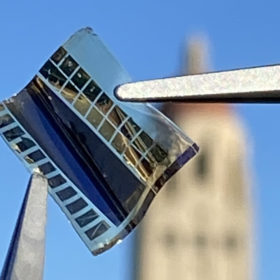
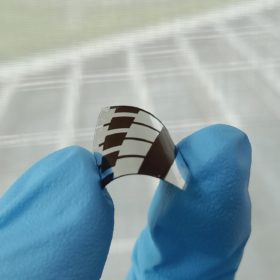
Flexible metal dichalcogenide solar cell with 5.1% efficiency
Stanford scientists have fabricated a transition metal dichalcogenide (TMD) solar cell that is claimed to overcome the typical issue of this kind of PV device, the so-called Fermi-level pinning. They used graphene contacts to mitigate this phenomenon and achieved a record power per weight of 4.4 W/g.
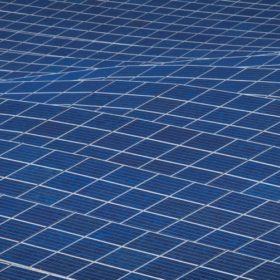
Three vastly divergent US solar deployment projections
The International Energy Agency, S&P Global Market Intelligence, and Rystad Energy have issued new renewable energy projections for the U.S. market that range from a 50% decline to a year-on-year surge in deployment.
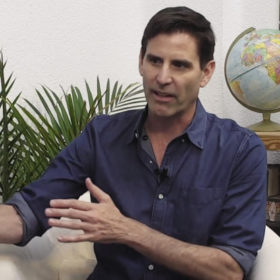
Grid stability and 100% renewables
New research from Stanford University professor Mark Jacobson seeks to remove any doubts about grid stability in a world powered entirely by renewable energy. The latest study models 100% wind water and solar powered grids across the United States, finding no risk of blackouts in any region and also broad benefits in cost reduction, job creation and land use.
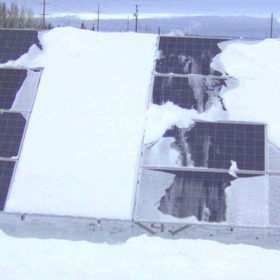
Icephobic surfaces for ice, snow shedding in utility scale solar
Developed by U.S. researchers, the proposed coating solution is claimed to effectively melt ice and snow with temperatures down to -35 degrees Celsius. It was fabricated by using medium-chain triglyceride oil to plasticize two common industrial polymer polyvinyl chlorides and tested at a pilot facility in Alaska.
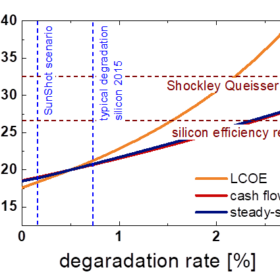
New metric for 50-year solar plant operation
A German-U.S. research group has proposed a new model to treat PV installations as permanent assets, with maintenance being performed at regular intervals. Through the new metric, it found more convenient to operate a module with 0.5% annual degradation for 35 years, and a module with 0.2% degradation, for 50 years.
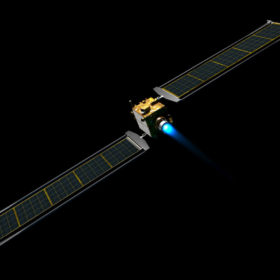
NASA to test solar-powered propulsion for asteroid defense
NASA’s Double Asteroid Redirection Test mission will roll out solar arrays and an electric propulsion system to redirect Earth-bound asteroids.
