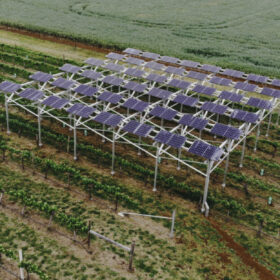
Australian university testing 20 kW agrivoltaic system on vineyard
Australian renewables company Greenwood has installed 48 solar panels at the University of Melbourne’s Dookie Campus vineyard to aid research on how agrivoltaics affect crop yields.

Spain’s Acciona Energía to develop agrivoltaics over canal
The agrivoltaic project, with a production capacity of up to 5,011 MW, will cover 2 km of the Orellana Canal in Cáceres, western Spain.
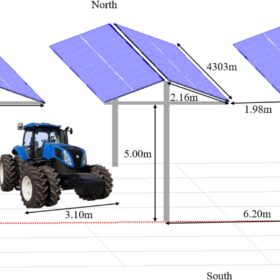
How to combine off-grid agrivoltaics with large-scale hydrogen production
Scientists in the United Kingdom have simulated how a 1 GW off-grid agrivoltaic facility may be used to fuel hydrogen fuel electric cell vehicles across Australia, California, China, Nigeria, and Spain. Their techno-economic analysis showed that the proposed combination could provide a levelized cost of hydrogen ranging from $3.90/kg to $8.13/kg.

Agrivoltaics for peppers
Scientists have built in India a 1.8 kW agrivoltaic setup to grow peppers under the PV modules. The proposed project design is described as an agrivoltaic insect net house that could be use for all crops that require rigorous pest management.
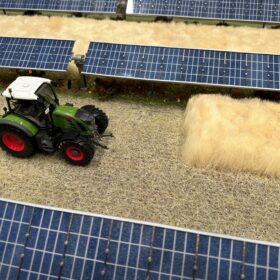
Italy allocates 1.5 GW in agrivoltaics tender
The Italian authorities have chosen 540 projects, totaling 1.5 GW, in the nation’s first agrivoltaics tender.

Agrivoltaics can increase grape yield by up to 60%
French agrivoltaics company Sun’Agri says that two of its facilities increased grape yields by 20% to 60% in 2024, compared to areas without solar panels. The PV modules helped regulate temperature fluctuations, reducing summer heat peaks and winter temperature declines.

Agrivoltaics can improve water conservation in Africa
Research led by the University of Sheffield installed an off-grid agrivoltaic system in Tanzania and a grid-tied agrivoltaic system in Kenya. They found the installations helped boost crop yield and conserve water while generating electricity at a lower cost than the national grid.

Colombian researchers design agrivoltaic system with hydroponic towers
Colombian researchers have designed an agrivoltaic system integrating hydroponic growing towers. The modular array, consisting of stackable 20 cm rings, creates a structure up to 2.5 meters tall, optimized for cultivating approximately 80 plants per square meter.
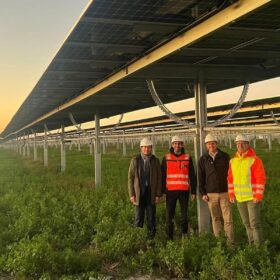
Austrian utility building 164 MW agrivoltaic plant
Burgerland Energie says it is building a 164 MW tracker-based agrivoltaic facility near Tadten-Wallern on Lake Neusiedl, southeastern Austria.
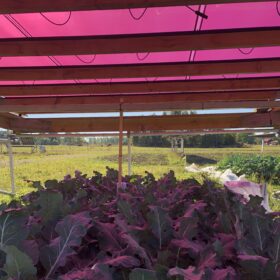
Wavelength-selective PV tech for agrivoltaic applications
Scientists in Sweden have conducted a comprehensive review of all wavelength-selective PV technologies for agrivoltaic installations. They suggested creating standards for reporting on the performance of these technologies.
